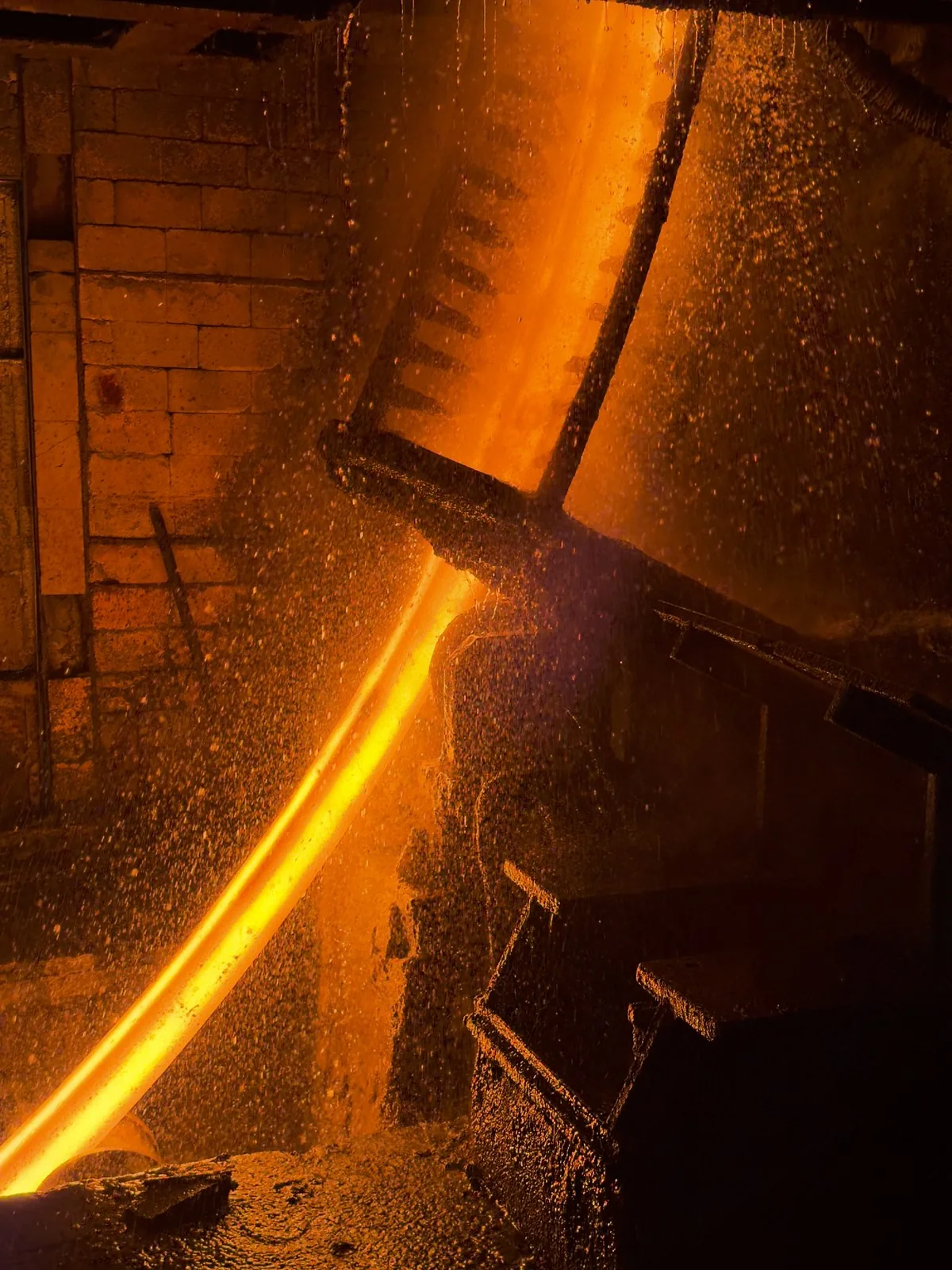
Think about a goldsmith melting down old jewellery. The moment that gold becomes liquid, it has no history. It doesn't know if it came from a temple heirloom or a broken chain. Once it's molten, the only thing that matters — the only thing that determines what the resulting piece will be — is the purity. The chemical composition. Nothing else.
Steel works the same way.
At approximately 1600°C, iron and its alloying elements become a liquid pool of atoms. At that moment, the furnace doesn't distinguish between iron extracted from ore last week and iron that was a reinforcement bar ten years ago. The atoms are identical. What the steel becomes — its yield strength, its ductility, its weldability, its structural reliability — is determined entirely by the chemical composition of that melt: how much carbon, how much manganese, what level of phosphorus and sulphur, what trace elements are present or absent.
This isn't an abstract metallurgical point. It is the entire argument for why primary steel is specified, and why it commands the standards it does.
Primary vs Secondary Steel — What Actually Matters
Steel quality is not determined by whether it comes from ore or scrap. Once molten, steel is defined entirely by its chemical composition and process control. Both primary and secondary steel can fully meet BIS IS 1786:2008 — the question is whether the producer controls composition heat-to-heat. Manufacturers who control chemistry consistently produce more reliable steel than those who depend on external material sources. A disciplined secondary operation consistently outperforms a careless primary one.
What Actually Determines Steel Quality
There is a widely held belief in the construction industry that "primary steel" — made from iron ore through a blast furnace — is inherently superior to steel made from scrap. It's worth examining that belief carefully. Because the goldsmith analogy cuts through it completely.
A jeweller melting down a mix of old gold chains, broken bangles, and temple ornaments doesn't get inferior gold. They get gold — the quality of which depends entirely on what they put in, how carefully they sorted it, and how rigorously they tested the melt. A jeweller who works with random, untested scrap will get variable results. A jeweller who characterises every incoming piece and controls the melt precisely will produce consistent, high-purity gold every time.
The same is true of steel. The critical word is not "primary" or "secondary" — it is control. What goes into the furnace, how well-characterised it is, and how tightly the resulting melt is managed: these are the variables that determine whether a bar meets IS 1786:2008 reliably, heat after heat.
At Ferrosco Industries, our Palavoor plant runs on a carefully characterised blend of sponge iron and sorted, tested steel scrap. Every incoming batch is checked for chemistry before it reaches the furnace. Every heat is built to specification — not corrected to specification after the fact. That distinction matters enormously.
Why Starting Composition Is Everything
Here is the insight that the goldsmith analogy crystallises so well: you cannot refine your way out of a bad starting point with complete confidence. Refining removes impurities and adjusts composition, but it works best when you know what you're starting with. The tighter your control over incoming chemistry — whether that incoming material is sponge iron, sorted scrap, or a blend of both — the more predictable and repeatable your output.
For Fe 550D grade steel — which must meet BIS IS 1786:2008 — the specification tolerances are genuinely tight:
- Carbon: maximum 0.30% — the primary determinant of strength and weldability
- Sulphur: maximum 0.055% — excess sulphur causes hot shortness and reduces ductility
- Phosphorus: maximum 0.055% — excess phosphorus causes cold brittleness
- Carbon Equivalent (CE): maximum 0.42% — governs weldability in the field
These aren't suggestions. They are the chemical thresholds that determine whether a bar will perform as designed under seismic loading, high tensile stress, or site welding — or whether it will crack, embrittle, or fail at lower loads than the engineer assumed.
The numbers make the steel
Two TMT bars that look identical on a construction site can have completely different structural behaviour. One meets the CE specification and can be safely welded on site. The other, with CE above 0.42%, risks hydrogen-induced cracking at the weld zone. You cannot see this difference. You cannot feel it. The only place it exists is in the chemistry — which is why certification and source traceability matter as much as they do.
The Real Distinction: Controlled Chemistry vs Uncontrolled Melting
The honest answer to "primary versus secondary steel" is: it depends entirely on how the secondary producer runs their operation. A scrap-based IF or EAF operation that characterises incoming material rigorously, blends deliberately, and tests at every stage of the melt can produce steel that meets — and exceeds — the same BIS specification as a primary blast furnace route.
The variable that actually matters is incoming material discipline. Construction scrap, industrial scrap, and end-of-life steel contain a wide range of alloys, coatings, and residual elements — copper, tin, chromium, nickel — that are difficult to remove once they enter the melt. These "tramp elements" degrade ductility and weldability over time. The difference between a well-run scrap operation and a poorly-run one is whether those elements are tested for and managed — or ignored.
✅ Controlled-Chemistry Production
- Incoming scrap and sponge iron characterised before charging
- Melt composition built to spec from known inputs
- Tramp elements tracked and managed
- Consistent heat-to-heat chemistry
- Predictable, repeatable mechanical properties
⚠️ Uncontrolled Melting
- Unknown or unverified incoming material mix
- Composition corrected after the fact, not designed
- Tramp elements ignored or untested
- Heat-to-heat variation accumulates over time
- Mechanical properties meet spec — sometimes
The first column describes what Ferrosco does. The second describes what gives secondary steel its poor reputation in the market — not scrap as a raw material, but the lack of discipline around it. The goldsmith who sorts and tests every gram of incoming gold produces fine jewellery. The one who throws random metal into the crucible does not.
The hidden risk: Steel that is not composition-controlled does not fail immediately — it fails unpredictably under load, welding, or long-term stress. By the time a failure is visible in a structure, the damage has already been accumulating at the material level for years.
Where Chemistry Control Actually Happens
Chemistry control happens at the melting stage — not at rolling. This is the most important technical point most buyers never hear, and it is where the real gap between producers opens up.
When billets are sourced externally, the rolling mill inherits the chemistry of those billets. At that stage, adjustments are limited — you can control rolling temperature and quenching profile, but you cannot change what is already in the metal. If the incoming billet has elevated sulphur, elevated tramp elements, or inconsistent carbon equivalent, the finished bar will reflect that. The rolling mill can optimise what it receives. It cannot transform it.
When billets are produced in-house — from a controlled incoming charge of known, characterised materials — chemistry is engineered from the start. The melt is designed to specification before it is tapped. Carbon, sulphur, phosphorus, and carbon equivalent are set deliberately, not inherited. This is the difference between controlling your quality and hoping the material you receive is already within spec.
This is the silent advantage of integrated manufacturing. It is not visible in the finished bar. It is visible in the consistency of test certificates across batches — and in the behaviour of the steel under real structural conditions over time.
Chemistry Sets the Ceiling. Processing Determines the Floor.
Here is where I would add one nuance to the goldsmith analogy: in gold, composition is essentially everything. In steel, composition sets the upper limit of what is possible — but thermomechanical processing determines how close you get to that limit.
Two steel heats with identical chemistry can perform differently if one was hot-rolled and air-cooled while the other was processed through Thermex quenching. The Thermex process — which Ferrosco uses for every bar of Tusker TMT 550D — rapidly quenches the bar surface from rolling temperature, creating a hardened martensitic outer ring around a soft, ductile core. This microstructural arrangement is what gives Fe 550D its combination of high yield strength and 16% minimum elongation. For a detailed walkthrough of this process, see our guide: How TMT Bars Are Made: The 7-Step Manufacturing Process Behind Tusker TMT 550D.
The point: Without the right chemistry going in, the Thermex process cannot deliver its full benefit. The composition — controlled at every step from incoming scrap characterisation through IF melt management to billet casting — determines what microstructure is achievable. The processing determines what microstructure is achieved. At Ferrosco, we control both. That is why Tusker TMT 550D consistently exceeds IS 1786:2008 minimum requirements, not merely meets them.
How This Applies in Practice — Ferrosco and Tusker TMT 550D
At Ferrosco Industries, chemistry is not adjusted after the fact — it is built at the melting stage. Our Palavoor plant runs on a carefully characterised blend of sponge iron and sorted, tested scrap. Every incoming batch is checked before it reaches the furnace. Every heat is designed to specification from known inputs.
This means tighter control over sulphur and phosphorus — the elements that form corrosion-initiating inclusions. Tighter control over carbon equivalent — the parameter that determines whether site welding is safe or a structural liability. And tighter control over consistency across batches — so that bar number 5,000 on a project performs identically to bar number 1.
The Thermex quenching applied to every Tusker TMT 550D bar operates on this foundation. Controlled chemistry going in. Controlled thermomechanical processing coming out. The result consistently exceeds IS 1786:2008 minimum requirements — not because we are lucky with our inputs, but because we design our inputs to make that outcome repeatable.
The Environmental Argument: Green Steel Is Already Here
There is a separate benefit to controlled scrap-based production that deserves to be stated plainly: it is significantly lower in embodied carbon than the conventional blast furnace route.
The ore-to-blast-furnace-to-BOF route is one of the most energy-intensive industrial processes on earth, producing approximately 1.8–2.0 tonnes of CO₂ per tonne of crude steel. A well-run operation using steel scrap and sponge iron produces a fraction of that — roughly 0.4–0.6 tonnes of CO₂ per tonne, depending on the power mix and input quality.
This is not a fringe position. It is the direction the global steel industry is already moving. The EU's Carbon Border Adjustment Mechanism (CBAM), international carbon credit frameworks, and green steel certification schemes are reshaping how steel is made and traded. Established primary steel producers are actively increasing their scrap and sponge iron ratios to reduce their carbon exposure — because the economics and regulatory pressure are pointing the same way. Ferrosco's production approach reflects where the industry is heading, not where it has been.
For builders working on IGBC-rated projects, for developers with sustainability commitments, and for an industry that will face increasing pressure to account for embodied carbon in structures, the chemistry is identical, the structural performance is identical, and the carbon story is substantially better.
Green steel doesn't have to wait for hydrogen DRI or carbon capture. A rigorous scrap-and-sponge-iron operation producing BIS-certified Fe 550D, with controlled melt chemistry and Thermex processing, is already a lower-carbon choice. The goldsmith who recycles old gold into fine new jewellery is doing something structurally identical to the one who starts from freshly mined ore — and leaving a lighter footprint along the way.
What BIS Certification Is Actually Certifying
BIS certification under IS 1786:2008 is, at its core, a chemistry and mechanical property audit. It verifies that the manufacturer can consistently produce steel within specified composition windows, and that the resulting bars meet minimum mechanical performance standards — yield strength, tensile strength, elongation, bend and rebend behaviour.
ISI marking on a TMT bar is not decoration. It means a third party has verified the chemistry is controlled and the resulting mechanical properties are real. For a builder or structural engineer, it is the minimum threshold for trust. For Ferrosco, it is the baseline — our internal quality standards for Tusker TMT 550D exceed BIS requirements because meeting the minimum is not the same as building to the maximum. Learn how to verify any TMT bar's BIS certification on site: How to Identify Genuine TMT Bars.
How to Identify High-Quality Primary Steel
When evaluating a primary steel supplier, look for:
- Valid BIS certification — request the licence number and verify it on the BIS portal
- Mill test certificates (MTC) for every heat, showing actual chemical composition values — not just "pass/fail"
- Consistent surface finish and rib pattern — dimensional uniformity reflects process control
- Traceability from cast number to bar — the ability to link any bar back to the heat it came from
- A manufacturer who owns their production process end-to-end — from raw material intake to finished bar — not one who sources billets and rolls them
For Tusker TMT 550D's full technical specifications — including chemical composition and mechanical property test data — see the Tusker TMT 550D product page.
What Poor Chemistry Looks Like in Real Structures
The consequences of uncontrolled steel chemistry are not theoretical. They are structural — and they develop silently, inside concrete, over years. Here is what poor chemistry produces in practice:
- Faster corrosion in humid and coastal environments — High sulphur and phosphorus create microscopic inclusion sites throughout the bar. These are where corrosion initiates. In Kerala or coastal Tamil Nadu, elevated impurities mean the corrosion front advances faster and deeper than specified materials would allow.
- Cracking during bending and welding — Elevated carbon equivalent (CE >0.42%) causes hydrogen-induced cracking at weld zones. Inconsistent carbon and tramp elements make bend behaviour unpredictable — bars that crack or delaminate during site fabrication are almost always a chemistry problem.
- Inconsistent strength across batches — When incoming chemistry varies, output mechanical properties vary. A batch that meets the yield strength specification may be followed by one that does not — particularly when testing frequency is low and tramp element buildup goes unmanaged.
- Reduced long-term structural durability — Structural design assumes specified material properties throughout the building's design life. Chemistry-driven degradation — through corrosion, reduced ductility, or embrittlement — creates a gap between what was designed and what is performing inside the concrete.
None of these failures announce themselves. Steel does not fail loudly or immediately from poor chemistry. It degrades — from within, invisibly — until the damage is structural rather than merely material.
Applications Where This Distinction Is Non-Negotiable
For low-rise residential construction in benign environments, the practical difference between well-made secondary steel and primary steel is small. Both can meet IS 1786:2008. Both will serve adequately in most standard applications.
The distinction sharpens significantly in these scenarios:
- Seismic zones: Ductility requirements (minimum 16% elongation, UTS/YS ratio ≥ 1.08) demand tight chemistry and process control. Tramp elements and inconsistent carbon can reduce ductility unpredictably.
- Coastal and high-humidity environments: Corrosion resistance is influenced by phosphorus and sulphur levels — another composition-controlled property. Widely used across Tamil Nadu and Kerala, where consistent ductility and weldability are critical for coastal and seismic conditions.
- Site welding: Carbon equivalent specification is not optional when bars will be welded on site. A CE above 0.42% risks weld zone cracking that may not be visible but will initiate under cyclic loading.
- Large infrastructure projects: Bridges, flyovers, and rail structures carry constant cyclic loads over decades. The margin for material variability is zero.
The Argument, Stated Simply
There are no superior atoms. The iron atoms in steel made from ore are not inherently better than the iron atoms in steel made from scrap. The goldsmith is right — once it's molten, it's all the same pool of atoms.
What separates excellent structural steel from mediocre steel is control over what goes into that pool. Starting from known, characterised raw materials. Building composition to spec rather than correcting to spec. Tracking tramp elements. Controlling the rolling and quenching precisely. This is what allows a disciplined steel producer to hit tight tolerances heat after heat, year after year — regardless of whether the raw material is ore, sponge iron, or carefully sorted scrap.
That consistency is what BIS certification measures. It is what a structural engineer relies on when they specify Fe 550D. And it is what a builder is paying for when they choose a steel brand they trust. The debate over primary vs secondary steel misses this point entirely — the only question that matters is whether chemistry is controlled.
The atoms don't know where they came from. But the engineer knows exactly what's in them — and that is the whole point.
In structural steel, there is no margin for assumption. What is not controlled cannot be relied upon.
At Ferrosco, chemistry is not adjusted after the fact — it is built deliberately from the start. Every heat begins with characterised, known inputs. Every melt is designed to specification before it is tapped. That is the difference between meeting a specification and controlling it.
What You Should Ask Before Buying
If you are specifying or procuring TMT bars for a structural project, these are the questions that cut through brand reputation and price comparisons to what actually matters:
- Do you manufacture your own billets? — If the answer is no, ask who supplies them and what chemistry verification is done on incoming billets.
- Can you provide heat-level test certificates? — Not a generic certificate. A mill test certificate tied to the specific heat number of the consignment you are receiving, showing actual numerical values for carbon, sulphur, phosphorus, and CE.
- How is chemistry controlled during melting? — A serious producer will explain their incoming material characterisation process, melt sampling protocol, and how they handle heats that drift out of specification.
- What is the carbon equivalent of this batch? — If bars will be welded on site, this number is non-negotiable. CE ≤0.42% under IS 1786:2008 for Fe 550D. Ask for the actual value, not just a certification statement.
- Is your BIS certification current? — Verify the CM/L licence number on the BIS portal or via the BIS Care app. Certification is not permanent and must be renewed.
A supplier who answers these questions confidently, specifically, and in writing is demonstrating process discipline. A supplier who cannot — or deflects with brand reputation and dealer relationships — is telling you something important about how their quality is actually controlled.
Frequently Asked Questions: Primary vs Secondary Steel
Is primary steel better than secondary steel for construction?
Not necessarily. Both can meet BIS IS 1786:2008 if chemistry is controlled. The real question is whether the producer characterises incoming materials, builds composition to spec, and manages tramp elements consistently. A disciplined secondary operation producing Fe 550D can outperform a careless primary one.
What is the difference between primary and secondary steel?
Primary steel is made from iron ore through a blast furnace and BOF route. Secondary steel is made from scrap or sponge iron using an induction furnace (IF) or electric arc furnace (EAF). The key quality distinction is not the route — it is the level of chemistry control the producer exercises.
What is carbon equivalent (CE) in TMT bars and why does it matter?
Carbon Equivalent (CE) governs how safely a bar can be welded on site. IS 1786:2008 limits CE to a maximum of 0.42% for Fe 550D. Above this threshold, site welding risks hydrogen-induced cracking at the weld zone — a defect that may be invisible but can initiate failure under cyclic loading.
What are tramp elements in steel and how do they affect TMT bar quality?
Tramp elements — copper, tin, chromium, nickel — enter the melt from mixed scrap and are difficult to remove once molten. At elevated levels they reduce ductility and weldability. A well-run operation tests and manages them; a poorly-run one ignores them, creating unpredictable mechanical properties that may not surface until the steel is under real structural load.
How do I verify that a TMT bar has controlled chemistry?
Request the mill test certificate (MTC) for the heat batch — it should show actual numerical values for carbon, sulphur, phosphorus, and CE, not just pass/fail. Verify the BIS ISI licence number on the BIS portal (bis.gov.in). Tusker TMT 550D carries BIS certification under IS 1786:2008 and provides MTCs on request.
Tusker TMT 550D — Chemistry-First, Fully Integrated
Built from a controlled blend of sponge iron and characterised scrap at our Palavoor plant. Every heat built to spec — with Thermex quenching, BIS certification, and a lower-carbon footprint on every production run.
Request batch-specific test certificates before you buy.
See Product Specifications →