Kerala builds differently from the rest of India — and it has to. A state with one of the longest coastlines in South India, an annual monsoon that runs for months, and humidity levels that rarely drop below 70%, Kerala presents structural steel with a challenge that most other Indian states don't. The buildings that stand here for 50 years are built with that reality in mind. The ones that don't — weren't.
At Ferrosco Industries, we supply Tusker TMT 550D across Tamil Nadu and Kerala. We've seen what high-grade, well-manufactured steel does for structures in coastal and high-humidity environments — and we've heard what happens when builders cut corners on grade or source. Choosing the best TMT bars for coastal areas like Kerala is not about brand — it is about chemistry and process control. Here's what you need to know.
If you are searching for the best TMT bars for coastal construction in Kerala, the answer depends on chemistry control and manufacturing consistency — not just brand name. This article explains exactly why.
Best TMT Bars for Coastal Construction in Kerala
For coastal and high-humidity regions like Kerala, Fe 550D grade TMT bars with controlled chemistry — low sulphur and phosphorus content — offer better corrosion resistance than Fe 415 or Fe 500. Thermex-processed bars provide a dense outer martensitic layer that resists moisture penetration. Look for IS 1786:2008 BIS certification and a named, traceable manufacturer — not open-market stock.
Why Steel Corrodes Faster in Kerala (Coastal Conditions Explained)
⚠ Corrosion in steel does not start on the surface — it begins at microscopic defects inside the bar. By the time rust is visible on the outside of your concrete, significant internal damage has already occurred.
Corrosion is an electrochemical process. When steel meets moisture and oxygen, it oxidises — rust forms. In dry, low-humidity climates, this is slow. In Kerala, it is not.
Coastal salt air introduces chloride ions, which aggressively attack the protective oxide layer on steel. Once chloride penetration begins, corrosion accelerates — working from the surface inward, and from inside the concrete outward. The concrete doesn't protect the steel; the corroding steel eventually destroys the concrete around it.
- Monsoon rainwater penetrates concrete over time, especially in structures with poor cover or honeycombing
- Humidity maintains a constant moisture film on steel surfaces even between rains
- Salt-laden coastal wind carries chlorides kilometres inland — not just seafront properties
- High temperatures accelerate the corrosion reaction rate
- Repeated wet-dry cycles from monsoon and dry seasons widen micro-cracks in concrete cover
The result in poorly specified structures: rust staining, concrete spalling, loss of bond between steel and concrete, and ultimately compromised load-bearing capacity — often invisible until significant structural damage has already occurred.
Why Steel Grade Matters More Than Most Builders Realise
Not all TMT bars are manufactured the same way, and grade is not just about tensile strength. The chemical composition — specifically carbon equivalent and the controlled levels of impurity elements — directly affects corrosion resistance.
Fe 550D grade, as specified in IS 1786:2008, enforces tighter limits on carbon, sulphur, and phosphorus content compared to Fe 500 or Fe 415. Lower sulphur and phosphorus content reduces the formation of inclusions in the steel. Inclusions are the microscopic sites where corrosion preferentially initiates — in poorly controlled steel, they act as corrosion starting points embedded throughout the bar. In controlled-chemistry steel like Tusker TMT 550D, inclusion formation is minimised, which directly improves long-term durability in aggressive environments like Kerala's coast.
Fe 550D Chemistry — The Actual Numbers
Tusker TMT 550D is manufactured to IS 1786:2008 Fe 550D specifications: Carbon ≤0.22%, Sulphur ≤0.040%, Phosphorus ≤0.040%, Carbon Equivalent ≤0.42%. These tighter limits mean better corrosion resistance, fewer internal defect sites, and a steel that performs better in high-humidity coastal environments — not just in a tensile test.
Fe 550D vs Lower Grade Steel in Coastal Conditions
This is the comparison most specification documents don't make explicit. Here's what the grade differences mean in practice for a building in Kerala:
Standards such as IS 1786:2008 define the permissible limits for impurity elements — carbon, sulphur, phosphorus, and carbon equivalent — in TMT bars used for reinforced concrete construction in India.
| Grade | Impurity Control | Inclusion Risk | Coastal Performance |
|---|---|---|---|
| Fe 415 | Higher permissible S+P levels | Higher — more corrosion initiation sites | Poor — faster corrosion initiation |
| Fe 500 | Moderate limits | Moderate | Moderate — acceptable, not optimal |
| Fe 550D ✓ | Tightest limits under IS 1786:2008 | Minimised — controlled chemistry reduces defects | Best — low impurities + ductility requirement |
The 'D' designation in Fe 550D is not cosmetic — it mandates specific ductility requirements (elongation and UTS/YS ratio) that are absent from standard Fe 550. This matters in seismic and cyclone-prone zones, where Kerala's coastal districts frequently appear.
Why Thermex Processing Slows Corrosion
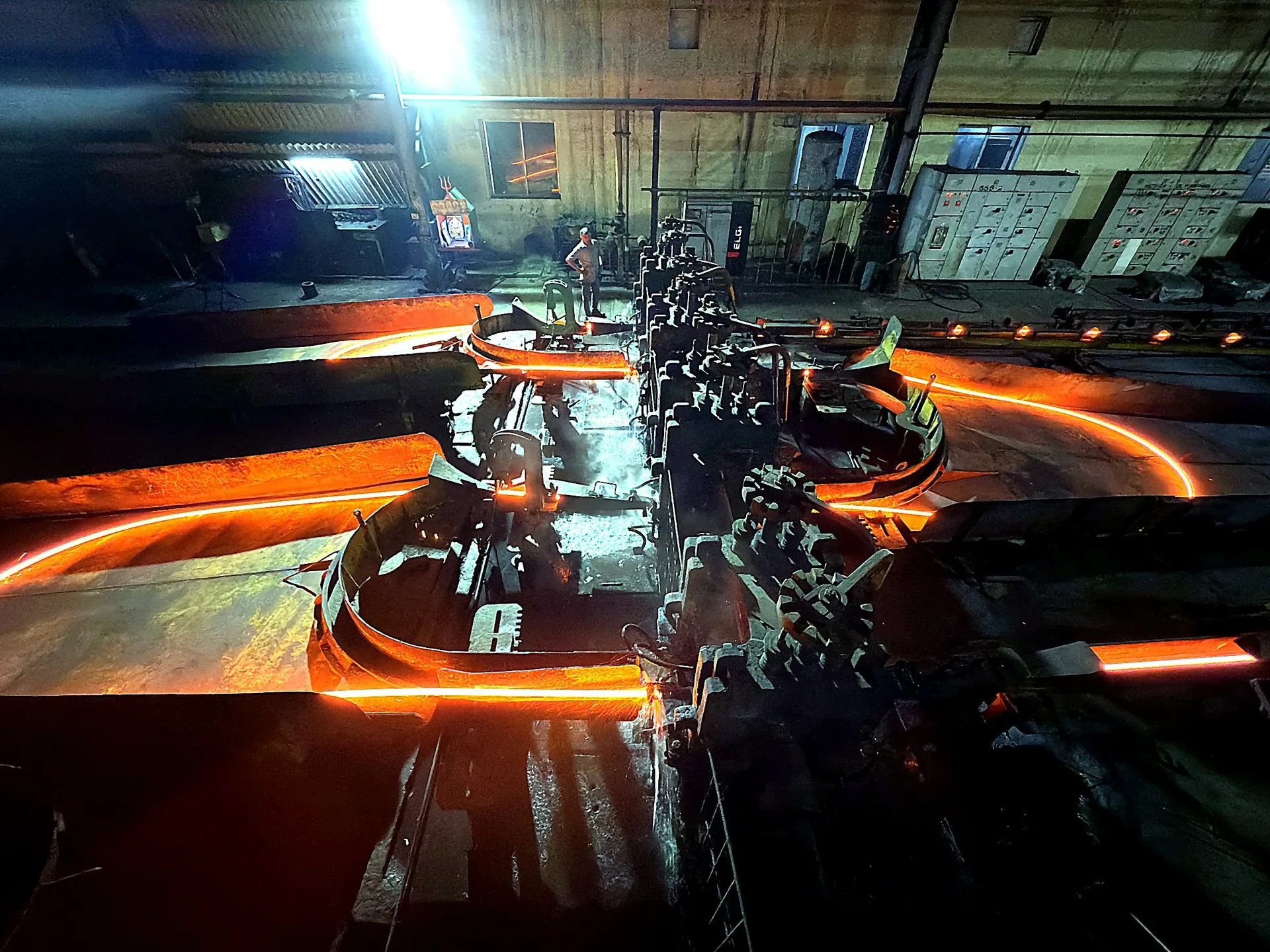
Tusker TMT 550D bars are produced using Thermex technology — a controlled quenching and self-tempering process applied immediately after rolling. The bar's surface is rapidly cooled, forming a hard, dense martensitic outer ring. The core remains relatively soft and austenitic, then self-tempers as heat from the core radiates outward.
The dense martensitic outer layer is the key differentiator for corrosion performance. Martensite has a fine crystalline grain structure with very low porosity — significantly harder to penetrate than the looser microstructure of conventionally rolled steel. Moisture and chloride ions face a denser barrier before they can reach the steel beneath. This physically slows the corrosion front in high-humidity, salt-air environments like Kerala's coast.
Compare this to poorly controlled or non-Thermex steel: the outer layer is more porous, and the absence of chemistry discipline means inclusions are scattered throughout the bar at both surface and depth. Chloride ions find multiple entry paths simultaneously. In Tusker TMT 550D, the combination of a dense outer layer and clean chemistry removes both vulnerabilities. The result is not just stronger steel — it is steel that is structurally more durable in the specific environment Kerala builders face every monsoon season.
What to Specify for Kerala Construction
If you are building in Kerala — whether coastal or inland — here is what your structural specifications should include:
- Grade: Fe 550D minimum for RCC structures. Do not accept Fe 415 or ungraded "local" bars
- Certification: IS 1786:2008 BIS certified — verify the CM/L licence number with the manufacturer
- Test certificate: Required for every consignment — chemical and mechanical test results for that specific heat number
- Concrete cover: Increase nominal cover by 5–10mm beyond IS 456:2000 minimum for coastal and high-humidity zones
- Source: Buy from an authorised dealer of a named, BIS-certified manufacturer — not from the open market
📖 Want to go deeper on how Tusker TMT 550D is manufactured and verified?
Corrosion-Resistant Steel Saves Money — Significantly
The upfront price difference between Fe 550D and lower-grade steel is small — often ₹1,000–2,000 per tonne. The cost of repairing a structure where inferior steel has corroded inside RCC columns or beams runs into lakhs, requires major disruption, and in severe cases is not economically viable. The structure must be demolished.
A 1,500 sq ft residential building uses roughly 6–8 tonnes of TMT steel. The grade upgrade from Fe 500 to Fe 550D adds approximately ₹8,000–16,000 to the total project cost — less than 0.1% of the total construction budget for most Kerala homes. The structural lifespan difference is measured in decades.
In coastal construction, steel does not fail loudly — it fails slowly, from within. The difference lies in what you choose before the concrete is poured.
Tusker TMT 550D — Built for South India's Climate
Fe 550D grade, IS 1786:2008 BIS certified, Thermex quenched. Trusted by builders and dealers across Tamil Nadu and Kerala. Contact us for specifications, test certificates, or to find your nearest authorised dealer.
Talk to Our TeamFrequently Asked Questions
Which TMT bar is best for coastal areas in Kerala?
Fe 550D grade TMT bars with low sulphur and phosphorus content offer the best corrosion resistance for coastal construction. Look for IS 1786:2008 BIS certification and bars produced using Thermex quenching technology, which creates a dense outer layer that resists moisture penetration. Avoid ungraded bars or open-market stock with no traceable test certificates.
Why does steel corrode faster in Kerala?
Kerala combines three aggressive factors simultaneously: high year-round humidity (70–90%), a long monsoon season with over 120 rainy days, and 590km of coastline that carries salt-laden air far inland. Chloride ions from coastal air attack the natural oxide layer on steel. Repeated wet-dry monsoon cycles widen micro-cracks in concrete cover, giving moisture a direct path to the steel inside. Corrosion begins at microscopic inclusion sites inside the bar — often long before any external sign appears.
What is the difference between Fe 415, Fe 500, and Fe 550D for coastal construction?
Fe 415 has higher permissible impurity levels, meaning more sulphur and phosphorus — which form inclusions where corrosion starts. Fe 500 offers moderate performance. Fe 550D enforces the tightest limits on carbon, sulphur, and phosphorus, meaning fewer internal defect sites. The 'D' suffix adds a ductility requirement absent from basic grades. For Kerala, Fe 550D is widely recommended as the minimum specification for RCC structures in aggressive environments.
Does Thermex-processed TMT resist corrosion better than ordinary TMT?
Yes. The Thermex quenching process creates a hard, dense martensitic outer ring on the bar. This layer is significantly less porous than conventionally rolled steel, making it harder for moisture and chloride ions to penetrate. Combined with controlled chemistry that minimises inclusion formation, Thermex-processed Fe 550D bars offer a clear structural advantage over ordinary rolled TMT in coastal environments.
Is Fe 550D available from dealers across Kerala?
Yes. Tusker TMT 550D is distributed through authorised dealers across South Tamil Nadu and Kerala, including Thiruvananthapuram district, Tirunelveli, Madurai, Kanyakumari district, and Thoothukudi. Contact us to find your nearest authorised dealer and request mill test certificates for your consignment.