A TMT bar looks identical whether it comes from a fully controlled plant or from a mill with inconsistent raw materials.
But inside that bar, the difference can determine whether a structure absorbs stress safely — or develops cracks over time.
The risk is invisible at the time of purchase. It only shows up years later.
This is how every bar of Tusker TMT 550D is made at Ferrosco Industries' plant in Palavoor, Tirunelveli — seven tightly controlled steps, each one building on the last.
What Is a TMT Bar?
TMT stands for Thermo-Mechanically Treated. It describes a specific manufacturing process in which a steel bar is hot-rolled and then immediately subjected to rapid water quenching, followed by self-tempering from the bar's own residual heat. This treatment creates a bar with a hard outer ring (martensite) and a tough, ductile core (ferrite-pearlite) — a combination that gives Fe 550D grade steel its characteristic high yield strength alongside the flexibility needed to survive seismic loading and site bending.
The process is standardised and the product is certified under BIS IS 1786:2008. But within that standard, the difference between an excellent bar and a merely compliant one lies in how tightly every step is controlled. Here is what that looks like in practice. For a deeper look at how steel chemistry affects final bar performance, see our article on primary steel chemistry and why it matters.
Raw Material Intake and Chemistry Verification
Every production run begins before the furnace is charged. Incoming raw materials — a controlled blend of sponge iron and sorted steel scrap — are tested for chemical composition at intake. Carbon content, sulphur, phosphorus, and trace element levels are verified before any material is accepted for production. This step is not a formality. It is the foundation on which consistent final chemistry is built. Scrap that does not meet incoming specifications is rejected. Material that passes is logged, batched, and held for charging.
Melting and Melt Chemistry Control
The verified raw material blend is charged into the furnace and brought to approximately 1600°C — the temperature at which iron and its alloying elements become a liquid pool. At this point, the melt is sampled and tested. Carbon is adjusted to target, and alloy additions (manganese, silicon) are made to hit the precise composition window required for Fe 550D. The goal is to build the specification from known inputs, not to correct an unknown starting point. Once the melt chemistry is confirmed, the heat is ready to cast.
Billet Casting
The liquid steel is poured into billet moulds and allowed to solidify. The cast billets — typically 100mm × 100mm or 130mm × 130mm square sections — are the intermediate product that will be reheated and rolled into finished bars. Before they leave the casting bay, each billet is inspected for surface defects, shrinkage voids, and dimensional accuracy. Cast number traceability begins here: every billet is tagged so that any finished bar can be traced back to the specific heat it came from.
Hot Rolling
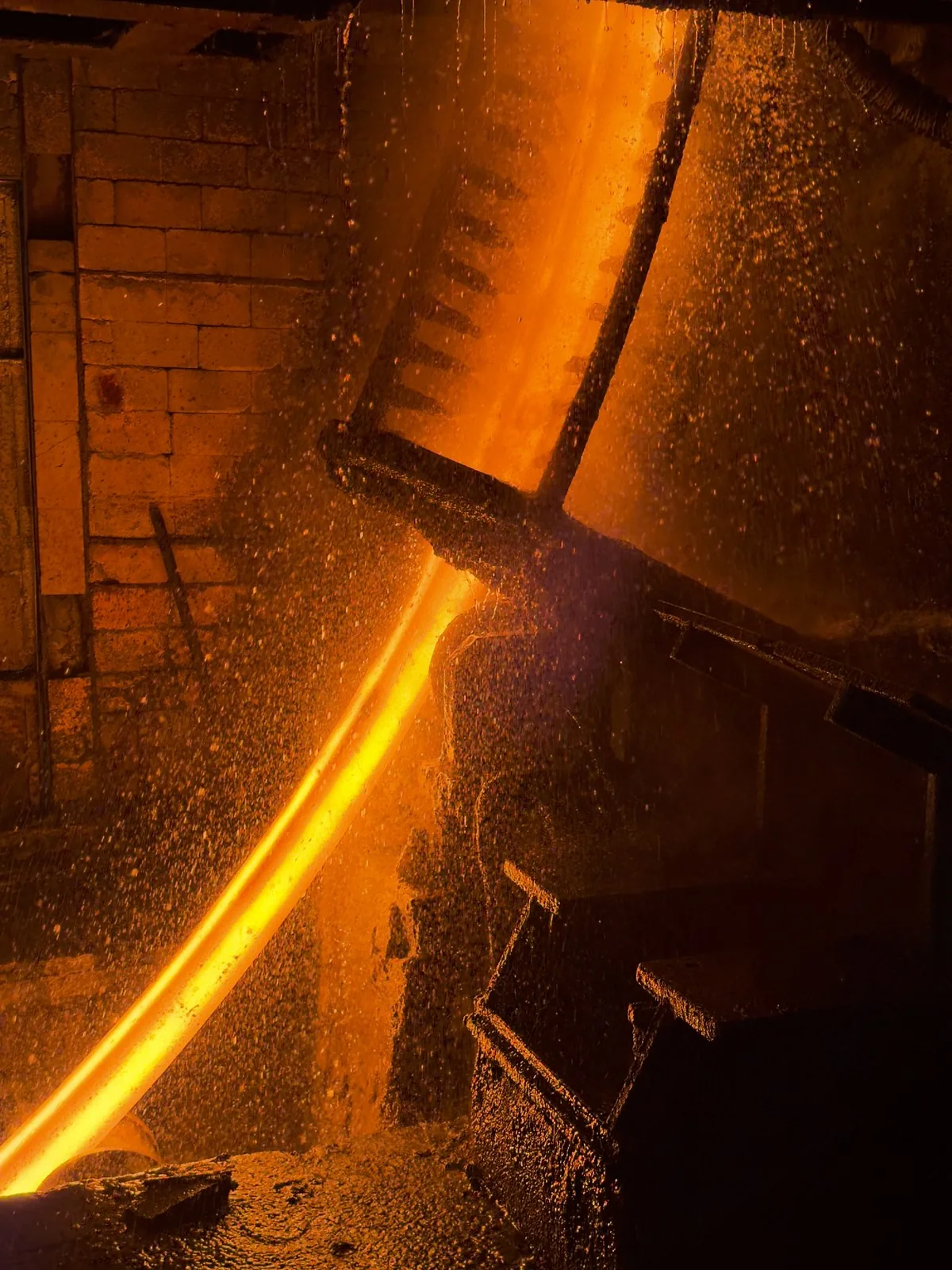
The heated billet passes through a series of rolling mill stands, each one progressively reducing the cross-section and elongating the bar. By the final pass, the billet has been reduced from a 100mm+ square section to a finished bar diameter — 8mm, 10mm, 12mm, 16mm, 20mm, or 25mm. The final rolling stand also forms the ribbed surface profile: the transverse and longitudinal ribs that improve mechanical bonding with concrete in reinforced structures. Rolling is a high-speed, high-temperature operation that must be precisely sequenced to maintain dimensional tolerance and surface quality.
Thermex Quenching
Immediately as the bar exits the final rolling stand — while it is still at rolling temperature — it passes through the Thermex quenching system. High-pressure water jets rapidly cool the outer surface of the bar, dropping the surface temperature below the martensite start point in a fraction of a second. The outer layer of the bar transforms into martensite: an extremely hard, high-strength crystal structure. The core, insulated by its own mass, remains austenitic and hot. This differential cooling is what gives TMT bars their layered microstructure — and it happens in less time than it takes to describe it.
Self-Tempering
As the bar exits the quench box, the residual heat from the core flows outward through the now-cooled outer layer. This reheats the martensite from within — a process called self-tempering — converting it from brittle untempered martensite into tough, resilient tempered martensite. The result is an outer ring that is hard and strong without being brittle, surrounding a soft, ductile ferrite-pearlite core that retains the bar's elongation and bendability. No external energy is required for this stage; the bar's own retained heat does the work. The precision lies in controlling the quench so that exactly the right amount of heat remains in the core to complete the tempering.
Atmospheric Cooling and Microstructure Finalisation
The bar is laid out on the cooling bed and allowed to cool naturally to ambient temperature. During this stage, the core completes its transformation to a fine-grained ferrite-pearlite structure. This is the microstructure that governs the bar's elongation, bendability, and long-term fatigue resistance. The three-layer cross-section — tempered martensitic outer ring, intermediate bainite transition zone, and ferrite-pearlite core — is now fully formed and stable.
Where Inferior TMT Bars Fail — and Why It Matters
In many rolling mills across India, control is not maintained at every stage of production:
- Raw material chemistry varies from batch to batch, with no systematic verification at intake
- Billets are sourced externally from third-party foundries — with limited or no traceability back to the original melt
- Quenching parameters are inconsistent, leading to uneven martensite depth or brittle outer layers
- Core microstructure is not uniform across the bar's length, creating weak zones that are invisible to the eye
None of these issues show up visually. A bar from a poorly controlled process looks exactly like a bar from a well-controlled one. The difference is not visible in the yard — it only shows up under stress.
In real-world conditions, these failures can lead to reduced ductility (bars that snap instead of bending under seismic load), poor mechanical bonding with concrete, and long-term crack development in structures. By the time any of this is visible, the structure is already built.
The uncomfortable reality: You cannot inspect quality into a TMT bar after the fact. The quality is locked in at the moment of manufacture — in the chemistry, the quench, and the control of every step. A bar that looks right may not perform right. The only way to know is to know how it was made.
The three-layer microstructure of Tusker TMT 550D
Cut a Tusker TMT 550D bar in cross-section and etch the surface — you will see three distinct zones. The outer ring (martensite): hard, high-strength, responsible for yield strength and tensile strength. The intermediate zone (bainite): a transition layer that bridges the hardness gradient. The core (ferrite-pearlite): soft, tough, and ductile — responsible for 16%+ elongation and the bar's ability to bend without cracking. This three-layer structure is why Fe 550D can meet both high strength and high ductility requirements simultaneously. One without the other is not enough.
Cutting, Bundling, and Traceability Marking
After cooling, bars are cut to standard lengths — typically 12 metres for structural use. They are straightened, inspected for dimensional conformance and surface finish, then bundled and tied. Every bundle is labelled with the bar diameter, grade (Fe 550D), batch number, cast number, and Ferrosco's ISI licence number. This labelling is not administrative formality — it is the chain of custody that allows any bar on any construction site to be traced back to the specific heat it came from, with its mill test certificate (MTC) available on request.
Quality Testing: What Happens Before a Bar Leaves the Yard
Each production batch is tested against BIS IS 1786:2008 before release. Testing includes:
- Chemical composition: Carbon, sulphur, phosphorus, manganese, silicon, and carbon equivalent — verified against specification limits for every heat
- Tensile test: Yield strength (minimum 550 MPa), ultimate tensile strength, and UTS/YS ratio (minimum 1.08) confirmed on sample bars from each batch
- Elongation test: Minimum 16% elongation — the ductility measure that determines whether a bar can absorb energy without fracturing
- Bend and rebend test: Bars are bent to 180° and rebent — verifying that the core remains sound and the bar does not crack at the weld line between martensite and core
- Dimensional check: Diameter, rib geometry, and linear mass per metre verified against IS 1786 tolerances
Only batches that pass all tests are released for dispatch. The test results are recorded in the mill test certificate, which accompanies every order.
One number to ask for: When specifying TMT bars for a critical project, always request the mill test certificate for the specific batch you are receiving — not a generic certificate. The MTC shows actual measured values for chemistry and mechanical properties, not just "pass." A producer who controls the process is happy to share this. A producer who does not control the process may not have it.
Why Full Integration Changes Everything
Most TMT bars in the market are produced in split processes. Steel is melted in one location. Billets are purchased and rolled elsewhere — sometimes by a completely separate company. This is common practice, and it creates a critical blind spot: the rolling mill does not control the chemistry of the steel it receives. It cannot. It didn't make the steel.
At Ferrosco, the entire process is integrated under one roof at Palavoor:
- Raw material selection and chemistry verification at intake
- Melting and melt chemistry adjustment to target specification
- Billet casting with cast-number traceability from the first pour
- Rolling to finished bar dimensions
- Thermex quenching with controlled parameters
- In-house mechanical and chemical testing before release
There is no external billet supplier. There is no handover point where chemistry control is delegated and records become someone else's responsibility. Every decision — from which raw material is accepted at the gate to how a heat is adjusted before casting — is made internally and documented.
This is not a minor operational detail. In structural steel, control equals reliability. And full integration is the only way to achieve full control. It is what makes a mill test certificate at Ferrosco traceable to a specific heat — not just a generic batch pass/fail document.
In structural steel, control = reliability. Full integration is the only way to achieve full control — and full traceability is the only thing that makes a mill test certificate genuinely meaningful.
Where Tusker TMT 550D Is Used
- Residential and commercial building frames in seismic zones III, IV, and V
- Bridges, flyovers, and elevated road structures requiring fatigue resistance
- Coastal construction — Tamil Nadu and Kerala projects where corrosion resistance is critical
- Industrial structures and warehouses with high imposed load requirements
- Infrastructure projects: water treatment plants, retaining walls, culverts
- Pre-engineered building columns and foundations requiring certified Fe 550D
What to Ask Any TMT Supplier
Before choosing a TMT brand for a structural project, there are three questions worth asking — regardless of brand name or price:
- Do you manufacture your own billets, or do you source them externally?
- Can you provide a batch-specific mill test certificate for the bars I am receiving — with actual measured values, not just a pass indication?
- Is your process fully integrated, or split across multiple vendors and facilities?
The answers to these questions often reveal more about a bar's actual quality than the grade printed on the label. A producer who controls the entire process will answer confidently. A producer who doesn't control it may not have the documentation to answer at all.
From Raw Material to Reinforcement
A TMT bar cannot be evaluated after construction. Its quality is locked in at the time of manufacture — in the chemistry, the quenching, and the control of every step. By the time a structure is loaded, it is too late to ask whether the bar was made correctly.
That is why the process behind the bar matters more than the bar itself.
Tusker TMT 550D is built on that principle — not as a claim, but as a system that can be traced, tested, and verified for every batch. Every bar leaves Palavoor with a BIS licence number, a cast-traceable mill test certificate, and a specification that exceeds IS 1786:2008 minimum requirements — documented, heat by heat. View our BIS certifications →
Tusker TMT 550D — Fully Integrated, Fully Traceable
From raw material intake to finished bar, every step happens at our Palavoor plant. View product specifications, available diameters, and how to request mill test certificates.
See Product Specifications →