When choosing TMT bars, most buyers compare three things: price, brand name, and what their dealer recommends. These are reasonable starting points — but they miss the variables that actually determine how a structure performs over its lifetime.
Structural steel is not a visible product after construction. Once it is inside concrete, you cannot inspect it, replace it cheaply, or verify its performance without destructive testing. The real difference between TMT brands lies in what you cannot see — chemistry, process control, and consistency. This is where the gap between average and high-quality steel begins.
What Makes One TMT Brand Better Than Another?
The meaningful differences between TMT brands lie in manufacturing integration, chemistry control, process consistency, and batch traceability — not surface finish or advertising. A fully integrated manufacturer who controls chemistry from raw material through finished bar, and provides heat-number-specific mill test certificates, is structurally more reliable than one who doesn't. This is the comparison that matters for your building.
The Problem with "All TMT Is the Same"
On the surface, most TMT bars look similar. They are round, ribbed, and stamped with a grade and certification mark. Most suppliers will tell you they are BIS certified. Most will quote you a price per tonne and move on.
But behind that surface uniformity, three things vary significantly between manufacturers — and these variations directly affect how a building performs over decades:
- Chemistry — the levels of carbon, sulphur, phosphorus, and alloying elements in the steel, which determine corrosion resistance, internal defect formation, and weldability
- Process control — whether quenching, rolling, and heat treatment are precisely controlled or variable between batches
- Consistency — whether what arrives in consignment 47 is the same quality as what arrived in consignment 12
These differences determine crack resistance, corrosion resistance, ductility under seismic load, and ultimately the structural lifespan of what you build. Widely used across Tamil Nadu and Kerala — where humidity and coastal exposure make consistency critical — Tusker TMT 550D is built for the specific demands of this region. Steel does not fail immediately — it fails over time, based on how it was made.
What Actually Differentiates a TMT Brand
Before comparing brands, it helps to understand the four technical factors that determine long-term performance:
Raw Material & Chemistry Control
Controlled carbon, sulphur, and phosphorus levels. Low inclusion formation. Consistent metallurgical structure from batch to batch.
Manufacturing Integration
Billet production and rolling under one roof. No dependence on external billet suppliers whose chemistry cannot be fully controlled.
Process Consistency
Uniform quenching and tempering. Stable microstructure. Verifiable batch-to-batch reliability — not just a single certified sample.
Traceability
Heat number on every batch. Mill test certificates with actual chemical and mechanical results. Every consignment verifiable against the standard.
These are the questions worth asking — not whether the bar has a BIS stamp, but how that bar was made, by whom, and whether the specific batch you received can be verified.
Where Tusker TMT Stands on Each Factor
Tusker TMT 550D is manufactured by Ferrosco Industries at our Tirunelveli plant. Here is what that means in practice across each of the four factors:
✓ Fully Integrated Manufacturing
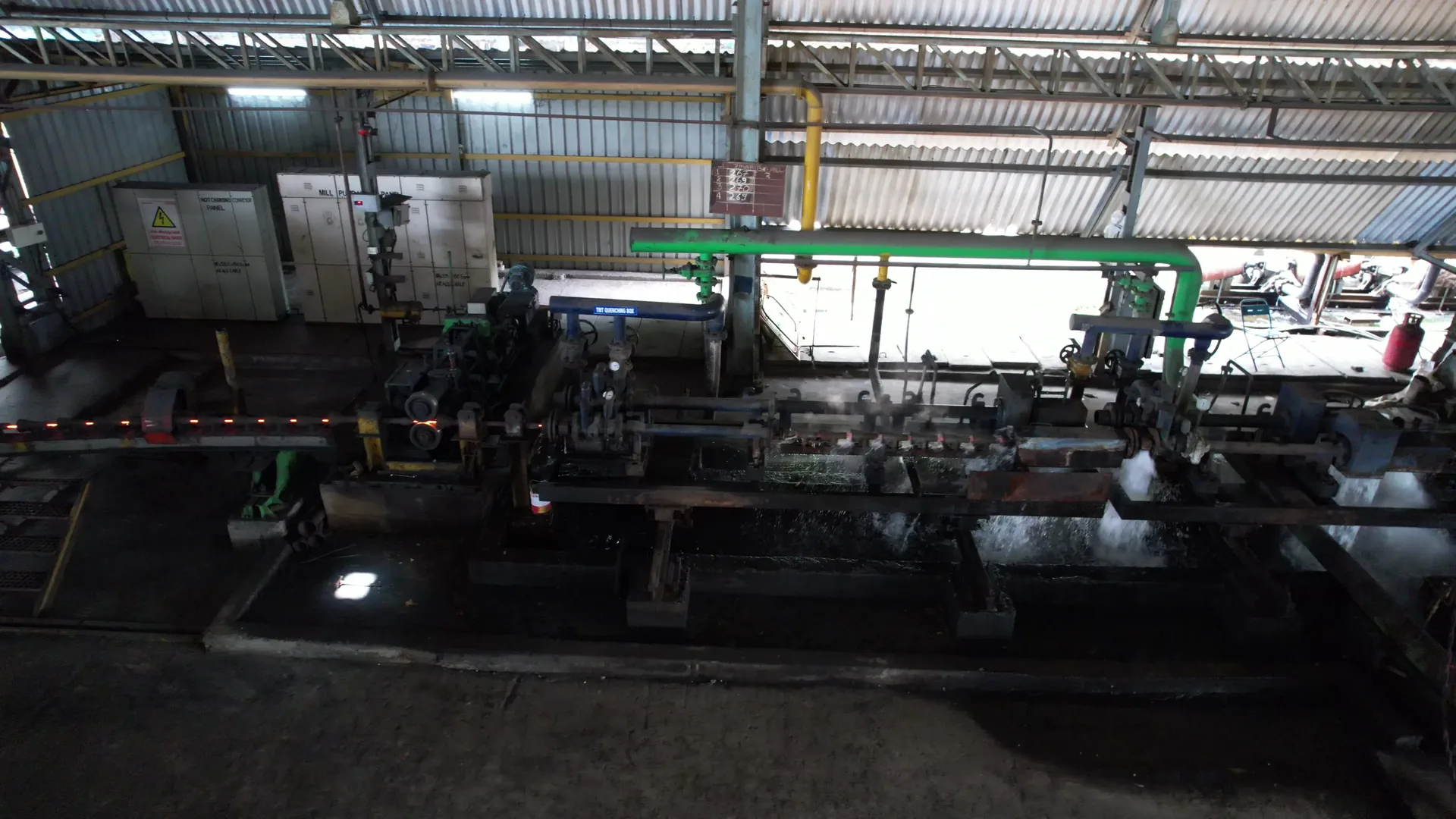
Raw material intake → melting → billet casting → hot rolling → Thermex quenching — all under one plant. No external billet dependency. Full chemistry control from the start of the process.
✓ Controlled Chemistry — Fe 550D
Carbon ≤0.22%, Sulphur ≤0.040%, Phosphorus ≤0.040%, CE ≤0.42%. Tighter than Fe 415 or Fe 500. Fewer inclusion formation sites means better corrosion resistance and long-term durability.
✓ Thermex Process Control
Controlled quenching forms a dense martensitic outer ring with a ductile tempered core. Strength and flexibility together — not a trade-off. Consistent microstructure across every bar in the batch.
✓ Full Batch Traceability
Heat number tracking through production. Mill test certificates issued per consignment with actual chemical and mechanical results. Every batch is independently verifiable.
What Integration Actually Means for Quality
When a manufacturer controls the entire process — from raw material input through to finished bars — they control every variable: chemistry, billet composition, rolling temperature, quenching profile. A manufacturer who sources billets externally inherits whatever chemistry was in those billets and has limited ability to correct it after the fact.
Integration means control. Control means consistency. Consistency is what determines whether bar number 5,000 in your project performs the same as bar number 1.
A note on context: Fully integrated manufacturing provides direct control, but high-quality steel can also be produced by non-integrated players with strong process discipline. The key is not integration alone — it is how consistently the process is controlled, and whether that consistency is independently verifiable through traceability.
How Many Competitors Differ
It is important to note that high-quality steel can be produced by both integrated and non-integrated manufacturers when strong process controls are in place. The distinction this guide draws is not about size or structure alone — it is about whether that control is verifiable.
Without naming specific brands, the structural reality of the market is this: a significant portion of TMT production in India involves non-integrated or semi-integrated manufacturers who source billets externally, operate with variable chemistry inputs, and provide limited traceability beyond the BIS stamp on the bar.
This does not mean such steel is always defective. It means the consistency and verifiability of the product depends heavily on the quality controls the manufacturer chooses to apply — which vary widely and are not visible to the buyer at the point of purchase.
Side-by-Side Comparison
| Factor | Tusker TMT 550D | Typical Non-Integrated or Variable-Process Steel |
|---|---|---|
| Manufacturing | Fully integrated Raw material to finished bar | Often split Billets sourced externally |
| Chemistry control | High Controlled at source | Variable Depends on billet supplier |
| Batch consistency | Verified Heat-number tracked | Inconsistent Limited controls |
| Traceability | Full Mill test cert per consignment | Limited BIS stamp only |
| Corrosion resistance | Better Low impurities + Thermex layer | Depends On source chemistry |
| Grade | Fe 550D IS 1786:2008 certified | Often Fe 500 or Fe 415 |
Why This Matters for Your Building
These differences are not theoretical. They have practical consequences for every structure built with the steel:
- Chemistry variability directly affects corrosion rate in humid and coastal environments like Kerala and coastal Tamil Nadu
- Inconsistent quenching produces variable microstructure — meaning some bars in a batch may meet spec while others do not
- Lack of traceability means there is no recourse or verification if a structural issue emerges years after construction
- External billet sourcing introduces an uncontrolled variable into every batch — one the rolling mill cannot fully compensate for
Inconsistent steel does not fail uniformly — it creates weak points that are impossible to detect once embedded in concrete. By the time a structural issue becomes visible, it is no longer a materials problem. It is a demolition problem.
Steel does not fail loudly or immediately. It fails slowly and invisibly, inside concrete, long after the builder has moved on and long before the structure reaches the end of its intended lifespan. The choices made at specification time are the only time these variables are controllable.
Questions to Ask Any TMT Supplier
Before specifying a brand for your next project, ask these directly:
- Do you manufacture your own billets, or source them externally?
- Can you provide a mill test certificate specific to this consignment's heat number?
- What is your process for controlling sulphur and phosphorus levels batch-to-batch?
- Is your BIS certification current — and can I verify the CM/L licence number?
- What grade is this bar, and what does the 'D' suffix mean?
A supplier who answers these questions confidently and in writing is demonstrating the kind of process discipline that correlates with consistent product quality. One who cannot — or won't — is telling you something important.
📖 Go deeper on the technical factors that make the difference:
Choosing a TMT brand is not about advertising, dealer incentives, or the lowest price per tonne. It is about control, consistency, and the ability to verify what you are actually buying — because once it is inside concrete, no one can check.
Ferrosco Industries Pvt Ltd is recognised under the Startup India initiative by the Department for Promotion of Industry and Internal Trade (DPIIT), Government of India.
Tusker TMT 550D — Chemistry-First, Fully Integrated
Fe 550D grade, IS 1786:2008 BIS certified, Thermex quenched, fully traceable. Ask us for mill test certificates or specifications for your next project.
Ask for batch-specific mill test certificates before you finalise your purchase.
Request SpecificationsFrequently Asked Questions
What makes Tusker TMT different from other TMT brands?
Tusker TMT 550D is produced through a fully integrated manufacturing process — from raw material through melting, billet casting, rolling, and Thermex quenching, all under one plant in Tirunelveli. This means direct chemistry control, batch-level traceability, and no dependence on externally sourced billets. Every consignment comes with heat-number-specific mill test certificates.
Does BIS certification mean all TMT brands are equal?
No. BIS certification confirms a manufacturer met minimum standards at the time of certification. It does not guarantee batch-level consistency, process integration, or that the specific bars you receive match certified quality. What matters is ongoing process control, chemistry discipline, and traceability — not just the mark on the bar.
Why does manufacturing integration matter for TMT quality?
When a manufacturer controls the full process — from raw material through to finished bars — they control every variable that affects quality: chemistry, billet composition, rolling temperature, quenching profile. Manufacturers who source billets externally inherit whatever chemistry was in those billets and have limited ability to correct it. Integration means control, and control means consistency.
What is a mill test certificate and why should I ask for it?
A mill test certificate (MTC) is issued by the manufacturer for a specific production batch, identified by a heat number. It contains actual chemical analysis and mechanical test results for that batch — not generic average values. Asking for an MTC lets you verify that the specific consignment you received meets the grade you paid for. Any reputable BIS-certified manufacturer should provide this without hesitation.
Is Fe 550D worth the premium over Fe 500 or Fe 415?
For RCC construction — especially in humid, coastal, or seismic zones — yes. The grade upgrade from Fe 500 to Fe 550D on a typical residential project adds a few thousand rupees to the total steel cost. The improvement in chemistry control, corrosion resistance, and ductility is structurally significant and measurable over a 30–50 year building lifespan. The question is not whether the premium is worth it. It is whether the structural risk of not specifying it is acceptable.