A family builds a home once in a lifetime. The steel they choose vanishes into the concrete on the first day and is never seen again — and then it holds up the roof over their children, and their children's children, for the next fifty years and more. They will never watch it being made. They have to trust that the work was done.
This article is about that work — the part that happens where no customer can see it. Because a reinforcement bar is not a product you get to inspect and return. It goes in once, and it stays. That permanence is exactly why every step behind it has to be earned.
Our earlier article walked through the seven steps that turn raw material into a finished Tusker TMT 550D bar. This one goes inside those steps — because the steps are not the hard part. Every TMT mill in the country melts, casts, rolls, and quenches. The hard part — the part you cannot see in a finished bar and cannot add back later — is the control inside each step: which scrap we accept, when we take a sample, what number releases a heat to the caster, and what we do when a sample tells us something we didn't want to hear.
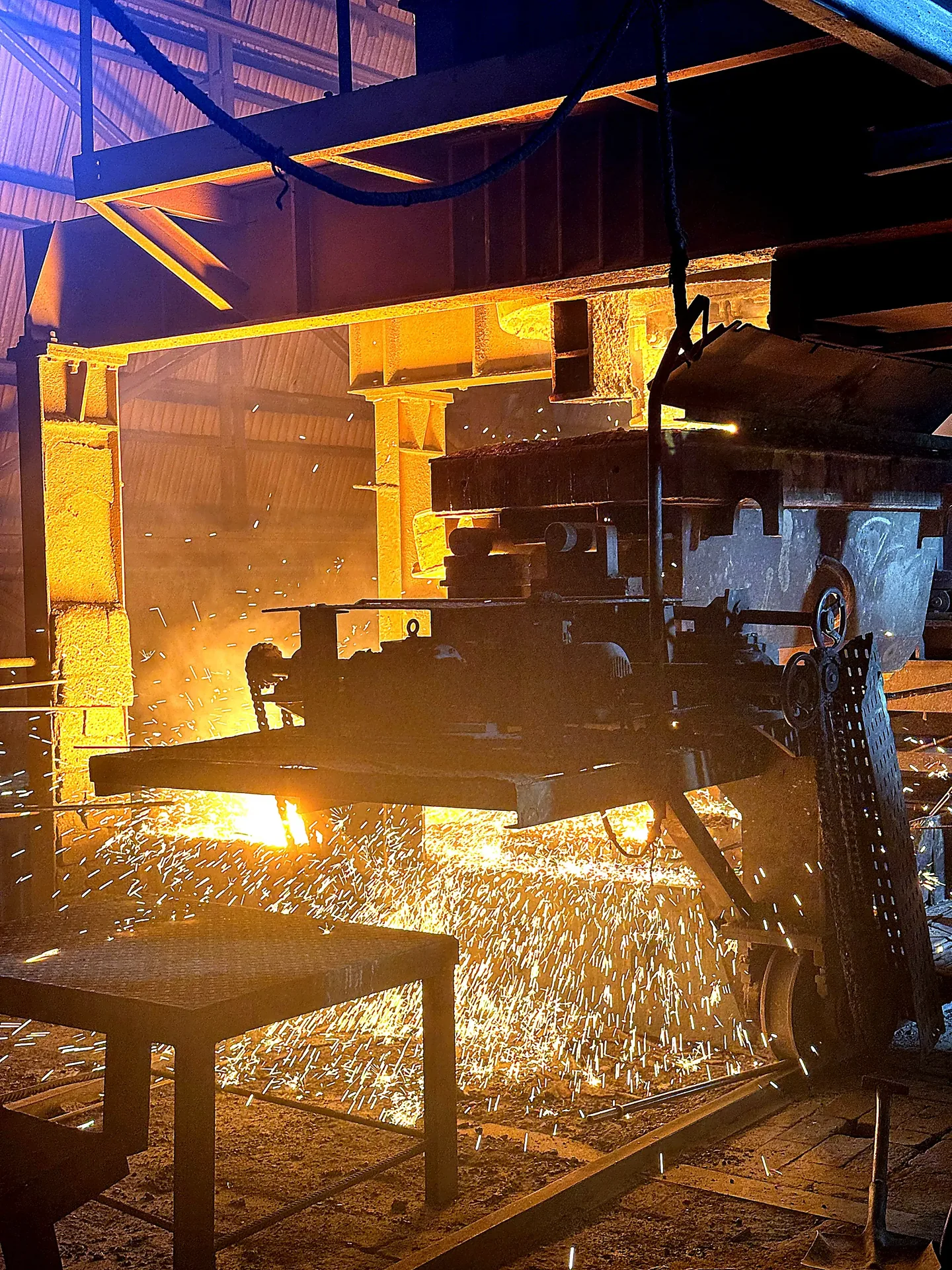
This is the story of a single heat of steel at our Palavoor plant — one furnace-full, from the moment scrap is sorted in the yard to the moment a cast billet is tagged with its heat number.
In plain terms: A "heat" is one batch of molten steel, one furnace-full. Everything here happens to that one batch before it becomes a bar. Get the batch right, and every bar from it is right. Get it wrong, and no amount of later testing can save it.
It Begins in the Scrap Bay, Not the Furnace
The quality ceiling of a bar is set before anything is melted. It is set in the scrap yard.
Steel scrap is not one material. It is dozens — and each carries its own baggage of residual (or "tramp") elements: copper, chromium, tin, lead, nickel. So sorting is not tidiness. It is metallurgy done with a magnet, a trained eye, and hard rules about what is allowed into a Tusker heat and what is not.
The first rule is where the scrap comes from. We do not buy scrap blind off the open market, where a load's history — and its residual elements — is anyone's guess. We prioritise institutional scrap of known provenance: surplus and decommissioned steel from the Kudankulam Nuclear Power Project, Indian Railways, State Transport Corporations, ISRO, Indian Rare Earths, and similar sources. This steel was made to a known specification, used in a known application, and released through proper channels. In other words: we know what went into the scrap before it ever goes into our furnace. Known input is the first and cheapest form of chemistry control there is.
The second rule is how we prepare it. Sorted scrap is not furnace-ready as it arrives. It runs through our processing line — balers to compact light scrap into dense, cleanly-charging bundles, a container/hydraulic shear to cut heavy and oversized sections down to chargeable size, and shredders that break scrap down and liberate the non-metallic and non-ferrous contaminants clinging to it. Each machine has one job: strip away what shouldn't be in the melt and present the furnace with clean, dense, uniform, "furnace-worthy" metal.
The honest part: We turn scrap away. A load that another mill would happily melt, we decline if its origin is unknown or its residual profile is wrong for 550D. Buying known-provenance scrap and shredding out contaminants costs more than buying a mixed market load as-is. It is far cheaper than discovering the problem in a customer's slab.
Why the Furnace We Use Makes the Charge Everything
Tusker TMT 550D is melted in an induction furnace. An induction furnace is superb at one thing: melting a known, clean charge to a precise chemistry, cleanly and repeatably. But it is not a refining furnace. Unlike an electric-arc furnace with oxygen lancing and an active slag practice, an induction furnace cannot "boil off" or slag away most residual elements once they are in the bath.
Put bluntly: you cannot take copper out of the melt. You can dilute it, but you cannot remove it. The same is largely true of chromium and other residuals, and even sulphur and phosphorus are stubborn to shift without the oxidising slag practice an induction furnace doesn't run. Whatever walks in with the scrap is, more or less, in your steel to stay.
This is not a weakness — it is a discipline. It means we cannot rely on refining to rescue a bad charge, so we don't build our quality on refining. We build it on inputs: clean, sorted scrap, and a deliberate blend of virgin iron units.
In plain terms: Some furnaces can clean the steel while it's molten. Ours can't — so we make sure only the right material goes in to begin with. It sounds like a limitation. In practice it forces a level of input discipline that sloppier processes never bother with.
Sponge Iron, Scrap, and the Myth of "Pure" Steel
Every Tusker heat is built on a deliberate blend of two raw materials: sorted scrap and sponge iron (direct-reduced iron, DRI), the material at the very start of our integrated chain.
Sponge iron earns its place because it is chemically predictable. Reduced directly from iron ore, it carries almost none of the copper, chromium, and other residuals that ride in with scrap — so blending it into the charge dilutes those tramp elements and steadies the starting chemistry. It is, in effect, a stabiliser we control from the source.
But predictable is not the same as free — and here it's worth being honest about something the industry often isn't. You will hear some producers position themselves as superior because they are "primary" manufacturers working with "new" steel — the quiet implication being that scrap-based steel is second-rate. It's a good story. It's mostly a story. In practice, virtually every steelmaker uses scrap, and under the green-steel transition and CBAM carbon-border rules now reshaping the industry, they are being pushed to use more of it, not less. Recycled steel is the low-carbon path; virgin iron units are the high-carbon one. Sponge iron may be predictable, but it is made by reducing ore with a great deal of energy and carbon — predictability bought at an environmental cost, and it is our children who inherit that bill.
So we don't chase "purity," because there is no such thing as pure steel. Steel is iron plus deliberate alloying — carbon, manganese, silicon — added on purpose to give a bar its strength, its ductility, its weldability. A bar with no alloys isn't a purer steel; it isn't structural steel at all. What has ever separated good steel from bad is not how "virgin" it is. It is how well its chemistry is controlled.
Why we aim for at least 50% recycled scrap
"Primary" or "new" steel isn't cleaner by nature — nearly everyone uses scrap, and increasingly must. There is no such thing as pure steel: every bar is iron plus deliberate alloys. So we deliberately aim for at least 50% recycled scrap in every melt — enough to be genuinely responsible about the footprint of what we make, balanced with enough sponge iron to hold the chemistry exactly where 550D demands. We earn our consistency through segregation, blending, and relentless sampling — not by pretending our steel was born pure, and not by burning more of the planet than the bar needs.
Charging, Melting, and Reading the Heat as It Builds
With the charge decided — sorted scrap and sponge iron in a deliberate ratio — the furnace is charged and energised. Induction stirs the bath as it melts, helping homogenise the pool so the sample we take represents the whole heat, not one corner of it. The charge is brought toward fully molten, around 1600°C — the point at which iron and its alloying elements form one uniform liquid.
We don't wait until the end to find out where the chemistry is heading — by then there is no room left to steer. So we read the heat as it builds, at three checkpoints:
First sample — at about 50% melt-down
Drawn while there is still ample molten room to act on what it tells us. On this reading we charge and correct the mix.
Recalibration — at around 80%
A second sample confirms how the corrected charge is behaving, and we adjust the mix and additions again if the numbers call for it.
Final sample — at 100%
By this point, confirming the chemistry is very nearly a formality. The decisions that made the heat conform were made far earlier.
The whole philosophy in one line
A heat that is right at 100% is right because of the work done at 50% and 80% — not because we got lucky at the finish. The decision the final sample "makes" was really made earlier, in the corrections no customer will ever see.
The Sample Cycle: Where Chemistry Is Won
At each of those checkpoints, the sample follows the same ritual. We draw a chill sample — a small disc of steel, cooled fast and prepared to a mirror finish — and read it on our Bruker Q4 POLO optical emission spectrometer, one of the top-tier OES instruments in its class. In seconds, it reports the full chemistry of the heat to the fine tolerances 550D demands: carbon, manganese, silicon, sulphur, phosphorus, carbon equivalent, and the residual elements we watched so carefully in the yard. A spectrometer this precise is what lets us hold an internal chemistry window tighter than the standard — you can only control what you can accurately measure.
Against that reading, we do the arithmetic:
- Carbon governs strength and, with the alloying elements, weldability. It is trimmed to target — added with a recarburiser if low, diluted if high.
- Manganese and silicon are trimmed with ferro-alloy additions to land inside the window. Deoxidation — killing the dissolved oxygen that would ruin the cast — is done with silico-manganese (SiMn) first, then aluminium as needed to finish the job.
- Carbon Equivalent (CE) is checked against our internal ceiling — held comfortably under the IS 1786 limit of 0.42% so that Tusker welds cleanly on site with no pre-heating.
- Sulphur, phosphorus, copper and chromium are the four we hold the hardest line on — precisely the elements an induction furnace cannot easily strip out once they're in the bath. Their real ceiling was enforced back at the scrap gate. Every point of sulphur or phosphorus is a corrosion-initiation site and a brittle grain boundary waiting to happen; every point of copper or chromium is a tramp element we can only dilute, never remove.
Then — and this is the part that separates process from luck — after every correction, a fresh disc, a fresh reading. We iterate until the chemistry sits inside our internal window, which we deliberately keep tighter than the BIS specification, not merely inside it. The standard is the floor. It is not the target.
A Rehearsal in Miniature: The 5 kg Sample Melt
Chemistry control doesn't only happen inside the main furnace. In our lab, a small 5 kg induction furnace lets us melt a representative sample on its own — a controlled, low-cost rehearsal that shows us how a particular charge or material will actually behave when it melts: how the chemistry lands, how the residuals carry through, how the melt characterises. It means we can understand a material before we ever commit a full heat to it — reading the character of the melt in miniature, not discovering it at scale.
In plain terms: Before betting a whole furnace on a batch, we melt a tiny sample first to see how it behaves. Cheap to learn on 5 kilograms; expensive to learn on a full heat.
What Actually Releases a Heat to the Caster
A heat is not "done" when it's molten. It is done when it has earned its way to the continuous casting machine (CCM). Before we tap, three things must be simultaneously true:
- Chemistry is inside our internal window — confirmed on a fresh spectrometer reading after the final correction, not an early one.
- Temperature is right — enough superheat above the steel's freezing point to cast cleanly through the tundish and mould, but not so much that it harms billet quality.
- The bath is properly deoxidised — oxygen killed with SiMn and, where needed, aluminium, so the cast strand is sound and free of blowholes.
Only when all three line up is the heat tapped and sent to the caster. Miss any one, and it waits, or it is corrected, or — sometimes — it does not become 550D at all.
The honest part: "It's basically fine" is not a release criterion at Ferrosco. A heat that is close but outside the window does not get waved through because the yard is busy or the order is urgent. The number decides, not the schedule.
When a Sample Doesn't Conform — What We Actually Do
Every mill's website talks about quality when everything goes right. Here is the part most don't publish: what happens when a sample comes back wrong. There are two cases, and they are very different.
Case one — an adjustable element is off. Carbon a little low, manganese under target, silicon light. These we correct. We make the addition, stir, re-sample, and re-read. The heat is only released once the corrected chemistry is confirmed. This is routine, and it is exactly what the sample cycle exists to catch.
Case two — the heat won't meet the 550D window. A residual like copper or chromium reads above our ceiling, or the composition otherwise can't be brought inside our internal specification. This is the case that reveals a mill's real standards, because — as we said earlier — we cannot refine it out. There is no addition that removes copper from that bath. At this point, there is no correcting the heat into a 550D chemistry.
So it does not become a 550D bar. Instead, that heat is cast and rolled into MS (mild-steel) square bars and round bars under IS 15911 — the standard for steel for re-rolling, which we are separately BIS-licensed to produce (CML 6400173406). Those MS squares and rounds are a legitimate, certified product in their own right, sold as exactly what they are — mild steel, not TMT. What that steel never does is get stamped Fe 550D and sold on the strength of hope.
The honest part: The bars that carry the Tusker 550D tag are the bars whose heat actually met the 550D chemistry. Full stop. A heat that misses 550D is one we paid to melt at premium cost and now sell as a lower-value product — a real, direct hit. The only way to rarely face that hit is to keep the copper out at the gate. Having the IS 15911 licence means an off-spec heat still becomes an honest, certified product — never a mislabelled one.
The Casting Cycle: Turning a Proven Heat into Billets
A released heat is tapped into a ladle and taken to the continuous casting machine. From the ladle it flows into a tundish — a reservoir that feeds the mould at a steady, controlled rate — and then into the water-cooled copper mould, where the outer skin of the strand solidifies. The strand is drawn down continuously, cooled by sprays as it goes, fully solidifying into a long square section that is cut into billets — typically 100mm × 100mm or 130mm × 130mm.
Control here is about steadiness. Casting temperature and casting speed are held in a narrow band: too hot or too fast and you risk internal defects and segregation; too cold and the strand won't feed cleanly. And we don't assume that steadiness — we sample billets during casting to confirm the chemistry is uniform from the first billet of the strand to the last. A heat that was proven in the furnace has to stay proven all the way through the cast.
Traceability is born at this moment. Every billet is tagged with its heat number as it's cut. From here on, any finished bar can be walked backward to the exact heat it came from — the same heat whose spectrometer readings we just described. That single thread is what later makes a mill test certificate mean something specific rather than generic.
Rolling: Straight From the Caster, and Under Temperature Control
Here we do something many mills don't: we roll the billets directly from the caster, while they are still hot. There is no reheating furnace — no letting a billet cool down only to burn fuel firing it back up to rolling temperature. The hot billet carries its own casting heat straight into the sequence of mill stands that squeeze the section down — 6mm through 25mm — and form the ribs that grip concrete.
Skipping the reheat furnace is one of the largest energy — and carbon — savings available to a rolling mill, and we take it deliberately. It is the same principle that runs through everything here: use the heat we already have, rather than spend more of the planet's energy than the bar actually needs. Efficient and green as far as is reasonably possible — without ever trading away control. It also means the steel follows a single, continuous thermal journey from cast to quench, instead of being cooled and reheated, which is one less place for the microstructure to drift.
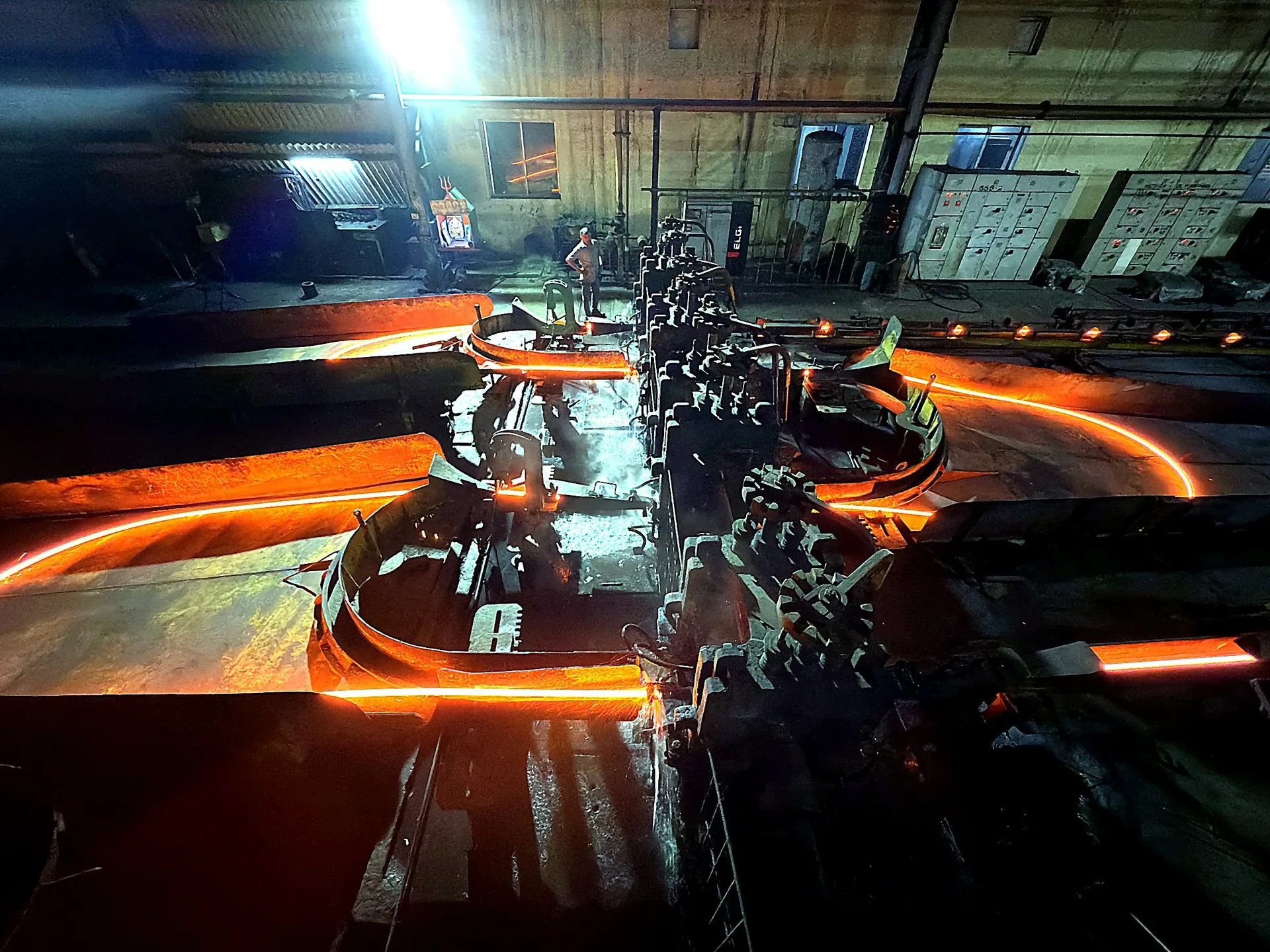
Those ribs are not decorative. The bond between a reinforcement bar and the concrete around it depends on the rib pattern being consistent and correctly formed along the entire length of every bar — and that consistency is engineered upstream, into the rolls themselves. We cut our rib profile into the rolls with a Sparkonix CNC rib-cutting machine — the CNC 560U — so the groove that forms each rib is identical roll to roll and bar to bar. Uniform rib geometry means uniform mechanical bond with cement: the same grip in every metre of every bundle, not a rib pattern that wanders with a hand-dressed roll.
But the rolling story that matters most for strength is a thermal one. The finished microstructure of a TMT bar is decided in a narrow temperature window at the end of rolling. The bar must exit the final stand at a controlled temperature and enter the Thermex quench box at the right moment, so the high-pressure water can drop the surface below the martensite-start temperature in a fraction of a second — forming the hard outer ring — while the core stays hot enough to self-temper from its own retained heat.
And it isn't only the steel's temperature we watch. In the mill we continuously monitor both the metal temperature and the quenching-water temperature, because the quench is only as consistent as the water doing it. If the water warms up over a long run, its cooling power drifts, and so does the depth of the hardened ring — the kind of silent variation that produces a bar that is "compliant sometimes." Watching both temperatures, in real time, is how we keep every bar's quench identical from the first metre to the last.
In plain terms: The strength of a TMT bar is set by how hot it is when it's quenched. Keep that temperature the same for every bar in the heat, and every bar behaves the same. This is why steady control beats occasional brilliance.
First, Middle, and End: Proving the Whole Heat
Here is a question worth asking any producer: when you test a heat, how many samples do you take, and from where? It matters more than it sounds. A single test sample can pass while bars rolled earlier or later in the same heat quietly drift out of spec. One sample cannot see that drift. It can only ever speak for itself.
So we don't rely on one. We pull mechanical test samples straight off the finishing line three times in every heat — once at the beginning, once in the middle, and once at the end — and test each against IS 1786:2008:
- Tensile test — each sample pulled to failure on our computerised 100-tonne universal testing machine (UTM), which records the full load–extension curve, not a single pass/fail light. It gives us yield strength (we run comfortably above the 550-grade floor, our bars at roughly 560 N/mm² and beyond), ultimate tensile strength, and the UTS/YS ratio, which we hold at or above the 1.08 minimum that guarantees a bar keeps stretching — and warning — before it breaks.
- Elongation — the ductility number, and the whole reason the grade carries a "D". Where plain Fe 550 can pass on single-digit elongation, the D (ductile) grade demands far more — and we hold Tusker at 16%+, the reserve that lets a bar bend hard at a column junction without cracking.
- Bend and re-bend — bars bent to 180° and back, proving the boundary between the hard ring and the ductile core is sound and won't split under real bending on site.
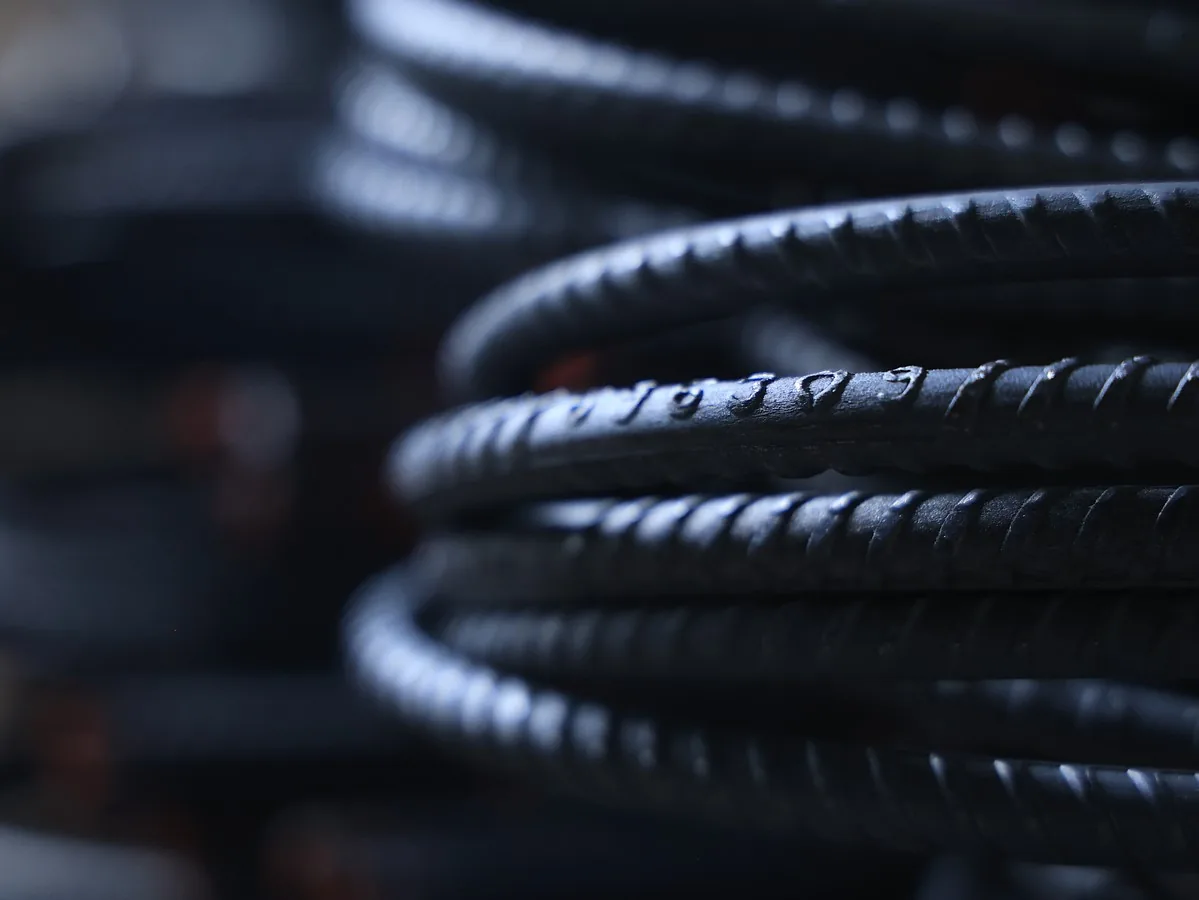
Testing the start, middle, and end means we're not certifying a sample — we're certifying the heat, end to end. If the numbers hold across all three, we know the bars in between are represented. If any one drifts, we know before a single bar ships, not after.
The honest part: One sample is easy to pass. Three, spaced across a heat, are honest — because they catch the drift a single sample is designed, intentionally or not, to miss. We test three because we would rather find our own problem in the lab than have you find it in a slab.
Why None of This Works Without Integration
Read back over this article and notice something: every decision that determined the quality of the bar happened before rolling, and most happened before casting — in the scrap bay, in the charge blend, at the spectrometer, at the release gate.
A mill that buys its billets from someone else inherits every one of those decisions blind. It did not sort the scrap. It did not set the charge. It did not read the melt or decide whether that heat deserved to be cast. It receives a billet and a claim, and rolls on trust.
At Ferrosco, there is no such handover. Sponge iron, scrap segregation, charge, melt, spectrometer, release, cast, roll, quench, and test all happen under one roof at Palavoor — which is the only reason we can tag a billet with a heat number and, later, hand you a mill test certificate that traces to that specific heat. Integration isn't a marketing word here. It is the physical precondition for every honest sentence above.
What You're Actually Holding
When you hold a Tusker TMT 550D bar, you are not holding the outcome of seven steps. You are holding the outcome of a few hundred small decisions — a load of scrap turned away, a blend adjusted for a batch that ran high on copper, a heat re-sampled until the carbon sat exactly right, a heat that didn't make the grade and never wore the tag, and three mechanical tests across one cast that all had to agree.
None of that is visible in the finished bar. That's the whole point — and the reason the process behind the bar matters more than the bar itself. Once it's set into your walls and columns, no one will ever inspect it again; it simply has to hold, quietly, for as long as the building stands. There is no second chance to get a bar right after it's poured. So we spend all our chances before — in the yard, at the furnace, on the caster, down the finishing line. Every step gets real work, because the family who builds on it only ever gets to trust that it did.
You don't have to take our word for any of it. Every Tusker TMT 550D bundle carries a QR code and lot number that pull the real mill test certificate for your exact heat — the measured chemistry and mechanical results, not a generic pass — at verified.tuskertmt.com. The steel that was proven three times over in our lab proves itself once more, in your hands.
Three questions worth asking any TMT supplier
1. Do you refine your steel, or select it — and if you can't refine out residuals, how do you control them?
2. What single number releases a heat to your caster — and who is allowed to override it?
3. Do you test one sample per heat, or the first, middle, and end?
A producer who controls the process will answer all three without hesitating. A producer who doesn't may not have the answers at all.
Tusker TMT 550D — Fully Integrated, Fully Traceable
From sponge iron to finished bar, every step happens at our Palavoor plant, IS 1786:2008 BIS-certified. View specifications, available diameters, and how to request a batch mill test certificate.
See Product Specifications →