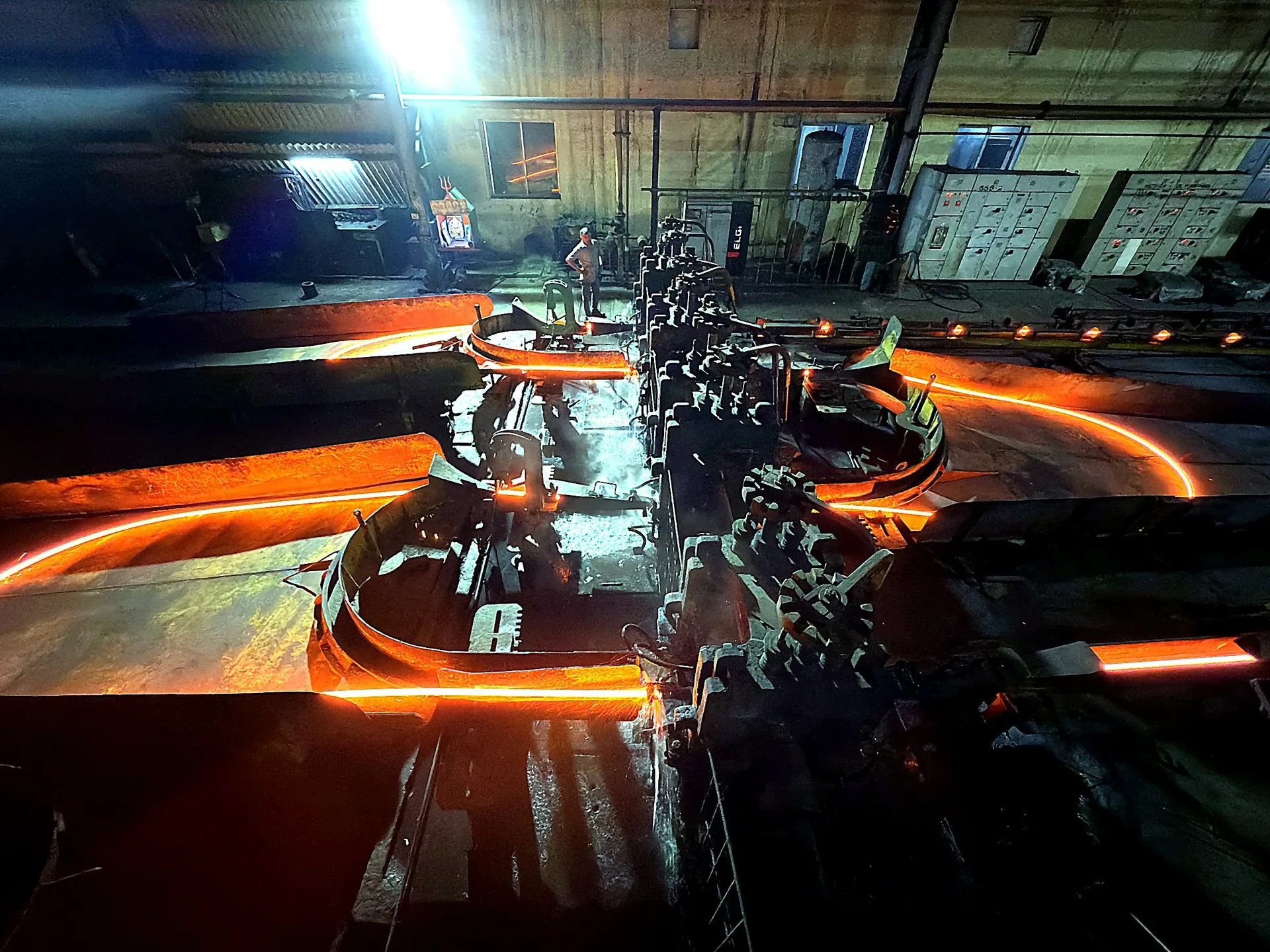
Most TMT marketing tells you a grade is "stronger" and stops there. That is not enough to specify steel for a structure that has to stand for fifty years. This page is the engineering reference we wish existed when we started manufacturing Fe 550D at Ferrosco Industries: what the grade actually requires under IS 1786:2008, what each number on a mill test certificate means, and how to tell a genuine Fe 550D bar from one that merely carries the label.
What is Fe 550D?
Fe 550D is the high-strength, high-ductility grade of deformed reinforcement bar defined in IS 1786:2008. "Fe" is steel, "550" is the minimum 0.2% proof (yield) stress of 550 MPa, and "D" is the ductility-controlled variant that enforces tighter impurity limits (carbon ≤0.25%, S ≤0.040%, P ≤0.040%, carbon equivalent ≤0.42%) plus a minimum elongation of 14.5% and a tensile-to-yield ratio of at least 1.08. It is the grade specified for durable, ductile RCC construction in India.
On this page
1. What "Fe 550D" Actually Means
The designation decodes into three independent pieces of information, each backed by a clause in IS 1786:2008.
- Fe — the material is steel (ferrous). Every grade in the standard shares this.
- 550 — the characteristic 0.2% proof stress, i.e. the minimum yield strength, is 550 N/mm² (MPa). A 550 designation does not run lower; it is a floor, not an average.
- D — the ductility-controlled variant. The plain grade (Fe 550) and the "D" grade (Fe 550D) share the same strength floor but the "D" grade adds mandatory ceilings on impurities and a mandatory floor on ductility.
That last point is the one most buyers miss. The difference between Fe 550 and Fe 550D is not strength — it is the guarantee that the steel will bend before it breaks. In a seismic zone or a cyclone-exposed coastal district, a bar that yields and stretches gives warning and absorbs energy; a bar that simply snaps does neither. Tamil Nadu and Kerala both contain Seismic Zone III areas, which is why we manufacture only the "D" variant.
2. Chemical Composition Limits (IS 1786:2008)
Chemistry is where quality is won or lost, because it is fixed at the steelmaking stage and cannot be corrected later by rolling. IS 1786:2008 sets these maximum permissible values for Fe 550D, by ladle analysis:
| Element | IS 1786:2008 limit (Fe 550D) | Why it is capped |
|---|---|---|
| Carbon (C) | 0.25% max | Higher carbon raises strength but reduces ductility and weldability |
| Sulphur (S) | 0.040% max | Forms inclusions; corrosion and crack-initiation sites |
| Phosphorus (P) | 0.040% max | Causes cold brittleness; reduces impact toughness |
| S + P combined | 0.075% max | Joint cap — both impurities together must stay low |
| Carbon Equivalent | 0.42% max | Governs weldability (see section 4) |
What a real Tusker TMT 550D heat looks like
From a published Tusker mill test certificate (12 mm bar, Heat No. 306): Carbon 0.20%, Manganese 0.60%, Sulphur 0.037%, Phosphorus 0.035%, Carbon Equivalent 0.30%. Every value sits inside the IS limit — and the carbon equivalent of 0.30% is well below the 0.42% ceiling, which is why these bars weld without preheating. These are not specimen targets; they are the production values recorded for that specific heat and printed on the certificate you can verify online.
The reason the "D" grade exists is precisely to police sulphur and phosphorus. In uncontrolled or re-rolled scrap-based steel, these impurities run high because the feedstock is uncertain. Inclusions formed by S and P are the microscopic sites where both fatigue cracks and corrosion preferentially begin — so a low S+P number is a durability number, not just a cosmetic one.
3. Mechanical Property Requirements
Chemistry sets the potential; the thermo-mechanical treatment (TMT/Thermex quenching) realises it. IS 1786:2008 requires every Fe 550D bar to meet all of the following:
| Property | IS 1786:2008 minimum (Fe 550D) | Tusker Heat 306 (12 mm) |
|---|---|---|
| 0.2% proof / yield stress | 550 MPa | 592 MPa |
| Ultimate tensile strength | 600 MPa | 698 MPa |
| TS / YS ratio | 1.08 min | 1.18 |
| Total elongation | 14.5% min | 17.0% |
| Bend / re-bend test | No cracks | OK / OK |
Two of these deserve explanation because they are the heart of the "D" grade:
The TS/YS ratio (tensile strength divided by yield strength) measures how much reserve a bar has after it starts to yield. A ratio of 1.08 minimum means the bar can carry at least 8% more load after first yield before it fails — that margin is what lets a frame redistribute load and warn occupants during an earthquake rather than collapsing suddenly. Heat 306's ratio of 1.18 is comfortably above the floor.
Total elongation of 14.5% minimum is the bar's ductility — how far it stretches before fracture. This is the property that distinguishes "D" steel and the one cheap bars most often fail.
4. Carbon Equivalent and Weldability
If you only learn one number from this page, learn carbon equivalent (CE). It is the single best predictor of whether a bar can be welded safely on site.
The IIW carbon equivalent formula
CE = C + Mn/6 + (Cr + Mo + V)/5 + (Ni + Cu)/15
The formula converts the hardening effect of each alloying element into an equivalent amount of carbon. The higher the CE, the harder and more brittle the heat-affected zone becomes when a weld cools — and the greater the risk of cold cracking. IS 1786:2008 caps CE for Fe 550D at 0.42%, and the practical reading is simple:
- CE below ~0.40% — weldable with ordinary practice, no preheating required for most bar sizes.
- CE 0.40–0.42% — weldable, but use low-hydrogen electrodes and consider mild preheat on thick bars.
- CE above 0.42% — out of specification for Fe 550D; high cracking risk.
Tusker Heat 306 measured CE 0.30% — comfortably in the "weld without preheating" band. For structural welds, follow IS 9417 (welding of cold-worked / TMT bars) and use low-hydrogen electrodes regardless of CE.
5. Fe 550D vs Fe 500D vs Fe 415
Choosing a grade is a design decision, not a brand decision. Here is how the common Indian rebar grades compare on the parameters that matter for a real structure.
| Parameter | Fe 415 | Fe 500D | Fe 550D |
|---|---|---|---|
| Min yield (MPa) | 415 | 500 | 550 |
| Carbon max | 0.30% | 0.25% | 0.25% |
| S+P max | 0.11% | 0.075% | 0.075% |
| Ductility ("D") control | No | Yes | Yes |
| Steel quantity for same load | Highest | Lower | Lowest |
| Best for | Light/legacy work | General RCC | High-rise, coastal, seismic, cost-optimised RCC |
The practical takeaway: moving from Fe 500D to Fe 550D raises the allowable design stress, so a structural engineer can often specify a slightly smaller bar or wider spacing for the same load — reducing the tonnage of steel in the building. That is why Fe 550D is frequently the most economical choice per square foot even though its price per tonne is marginally higher. For the full cost-per-kilogram logic, see our steel quantity estimation guide linked below.
🔗 Go deeper across the Tusker technical library
6. How to Read a Mill Test Certificate (MTC)
A mill test certificate is the document that proves a specific batch of steel meets the standard. It is your single most important quality record — and you are entitled to one for every consignment. Here is what each section means.
- Heat number — the unique ID of the steel melt the bars were rolled from (e.g. Heat No. 306). It ties the bars in your hand to a specific test result. No heat number, no traceability.
- Specification & grade — the standard claimed (IS 1786:2008) and grade (Fe 550D). These must match what you ordered and what is rolled on the bar.
- Chemical analysis — measured C, Mn, S, P and CE for that heat, each shown against the IS limit. Every value must be inside the limit.
- Mechanical properties — measured yield, tensile, TS/YS ratio, elongation and bend/re-bend result for that heat.
- CM/L licence number — the BIS certification-marks licence under which the bars were produced (Tusker: CM/L-6900106309 for IS 1786). This is the auditable link to BIS.
⚠ A mill test certificate with no heat number, or one that quotes only "typical" values rather than measured ones for a named heat, is not traceable. Treat it as no certificate at all.
7. Verifying a Genuine Fe 550D Bar
Three independent checks, none of which can be faked together:
- On the bar: the BIS Standard Mark, the manufacturer's identity, the grade, and the CM/L licence number are rolled into the rib pattern at intervals.
- On the bundle: a tag carrying the lot/heat number and a QR code linking to that batch's certificate.
- Independently: scan the QR tag or enter the lot number at the manufacturer's verification portal, and cross-check the CM/L number in the BIS Care app. For Tusker, every bundle's certificate is retrievable at the verification portal linked below.
Specify Fe 550D with confidence — Tusker TMT 550D
IS 1786:2008 certified (CM/L-6900106309), German Thermex quenched, with a verifiable mill test certificate for every heat. Manufactured by Ferrosco Industries, Tirunelveli, and distributed across Tamil Nadu and Kerala. Request specifications, an MTC sample, or your nearest authorised dealer.
Talk to Our Technical TeamFrequently Asked Questions
What is Fe 550D TMT steel?
Fe 550D is the high-strength, high-ductility grade of deformed reinforcement bar defined in IS 1786:2008. "Fe" denotes steel, "550" is the minimum 0.2% proof (yield) stress of 550 MPa, and "D" is the ductility-controlled variant with tighter limits on carbon, sulphur and phosphorus plus a mandatory minimum elongation and tensile-to-yield ratio. It is the grade widely specified for durable RCC construction in India.
What does the 'D' in Fe 550D mean?
The "D" stands for the ductility-controlled variant. Under IS 1786:2008 it imposes lower maximum carbon (0.25%), sulphur (0.040%), phosphorus (0.040%) and carbon equivalent (0.42%), and requires a minimum total elongation of 14.5% and a TS/YS ratio of at least 1.08. These rules make Fe 550D more ductile and more reliable in seismic and cyclonic zones than plain Fe 550.
What is the chemical composition limit of Fe 550D?
Carbon maximum 0.25%, sulphur maximum 0.040%, phosphorus maximum 0.040%, sulphur plus phosphorus maximum 0.075%, and carbon equivalent maximum 0.42%. A genuine mill test certificate states the actual measured values for that heat against these limits — for example, Tusker Heat 306 measured C 0.20%, S 0.037%, P 0.035%, CE 0.30%.
What is carbon equivalent and why does it matter?
Carbon equivalent converts the effect of alloying elements into an equivalent carbon value using CE = C + Mn/6 + (Cr+Mo+V)/5 + (Ni+Cu)/15. It predicts weldability: lower CE means easier, crack-free welding. IS 1786:2008 caps CE for Fe 550D at 0.42%; bars at or below this can generally be welded without preheating.
Is Fe 550D weldable?
Yes. Because IS 1786:2008 caps the carbon equivalent of Fe 550D at 0.42%, it is readily weldable using ordinary site practice. Bars with CE below about 0.40% generally do not require preheating. For structural welds, use low-hydrogen electrodes and follow IS 9417 welding procedures.
What is the difference between Fe 500, Fe 500D and Fe 550D?
Fe 500 has a 500 MPa minimum yield and looser impurity limits. Fe 500D adds ductility control at 500 MPa yield. Fe 550D raises the minimum yield to 550 MPa while keeping the strict "D" impurity and ductility limits — giving higher strength per kilogram, which can reduce the quantity of steel a design needs.
What are the mechanical property requirements for Fe 550D?
Minimum yield stress 550 MPa, minimum ultimate tensile strength 600 MPa, minimum TS/YS ratio 1.08, and minimum total elongation 14.5%. Bars must also pass a bend and re-bend test without cracking.
How do I confirm a bar is genuinely Fe 550D?
Check the BIS Standard Mark and CM/L licence number rolled on the bar and printed on the bundle tag; the mill test certificate for that specific heat number showing measured values against IS 1786:2008 limits; and an independent route such as scanning the QR tag or entering the lot number on the manufacturer's verification portal.
Does Fe 550D need more concrete cover or special handling?
No special handling beyond good practice. Cover requirements follow IS 456:2000 by exposure class, not by bar grade — though in coastal Tamil Nadu and Kerala an extra 5 to 10 mm of cover is prudent. Fe 550D bends, cuts and welds like other TMT bars; its advantage is strength and controlled chemistry, not different handling.